

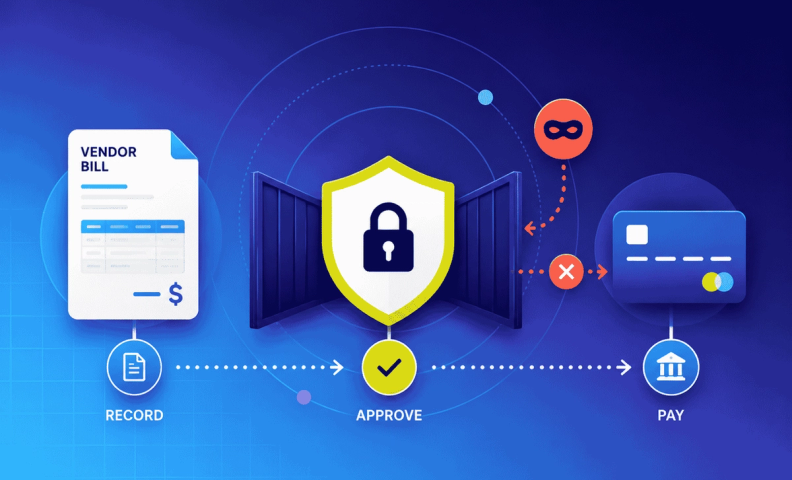
The accounts payable process is critical for every business because doing business means working with vendors, suppliers, or contractors. All those people expect to be paid and preferably in a timely manner!
But a good accounts payable process is also crucial because AP is one of the highest points of risk within your organization. Fraud is easy if there aren't good controls in place. This article is about what those controls need to be and how to put them in place.
We also throw in some tips, warnings, and general accounting education.
What accounts payable is
Accounts payable (AP) refers to money a company owes to its vendors. They are outgoing funds. It is a liability on the balance sheet.
Accounts receivable (AR) refers to money the company expects to receive from its customers. They are incoming funds. It is an asset on the balance sheet.
It is common to confuse some of the terminology used in these processes.
- Invoices refer to money we expect to receive.
- Bills refer to money we expect to pay.
Businesses often confuse this terminology because the documentation they receive from vendors says “Invoice” at the top because the vendor is sending them and they ARE invoices to the vendor. They represent money the vendor expects to receive.
However, to your organization, they are bills because they represent money you have to PAY.
They are an INVOICE to the VENDOR but a BILL to YOU, a mirror relationship of the same thing.
We bring this up because from this point forward we will refer to these as “bills” and I don’t want to confuse anyone.
The basic accounts payable process
Let’s say you need to order product from a vendor who lets you pay on terms of 30 days.
Not considering additional processes for controls, what would the basic process look like?
- You place a purchase order for the product with the vendor.
- The vendor sends you the product with a bill due in 30 days with payment information (i.e. a routing number or an address to mail payment to)
- You record the bill in your books, increasing your accounts payable, and make note of the payment information.
- You initiate payment to the vendor.
- You record this payment in your books against the bill you originally created to decrease your accounts payable appropriately.
This basic process is crucial for managing a purchase effectively and ensuring accurate invoice management.
Besides knowing what it is, it’s helpful to know how AP is different from other types of expenses in your business.
How are accounts payable different from other expenses?
A business typically experiences two kinds of expenses.
- It has expenses paid for at the time of service or receipt of goods.
- It has expenses from when services or goods are received, but not paid for until later.
An example of the first would be walking into a store, picking up office supplies, and paying for them at check out. This is a cash-based transaction where the expense is recognized at the time the payment is made.
It is a waste of your time to handle these transactions as accounts payable. Don’t create bills for them and then pay them. We recommend simply coding these expenses to the appropriate expense account as they hit your bank account and credit cards.
An example of the second kind would be buying inventory where your supplier gives you terms of 30 days before requiring payment. This is an accrual transaction because the expense is recognized by your business at the time the value is received, rather than when you pay. Because there is a time lapse between the time the value is received and the time the bill is actually paid, this creates a liability called Accounts Payable.
We DO recommend entering bills into your accounting system for these activities and managing payment against those bills.
How a strong AP process prevents fraud
Businesses handle AP in a variety of ways, ranging from simple with poor controls, to more complex with good processes and, most importantly, good controls.
AP is one of the highest points of risk within your organization because fraud is easy if there aren’t good controls in place.
At LedgerGurus, we found that one of our clients was unnecessarily paying hundreds of thousands of dollars to a vendor because there were not good controls in place to watch how money was being spent. Adequate controls and checkpoints in the accounts payable cycle are essential to prevent unauthorized purchases and ensure efficiency. For more real examples of how this fraud actually happens, see our podcast episode on ecommerce accounts payable fraud.
Here are 3 benefits of a strong AP process:
- Internal controls
- Cash flow & accurate financials
- Organization
Internal controls
Strong internal controls are essential to prevent fraud and ensure the integrity of the accounts payable process.
A well-designed AP process uses a system of checks and balances to make sure that everything is entered correctly and runs smoothly. Clear policies and procedures around invoice approval reduce unauthorized and unnecessary purchases and ensure timely payments, enhancing overall efficiency.
This not only helps eliminate any mistakes and human error in the accounts payable process, but it also reduces fraud by preventing any single person from having total control of the business’s money.
Cash flow & accurate financials
Keeping track of the money you owe and who you owe it to gives you needed insight when managing your business’s finances.
This helps you avoid errors, as well as strategize your spending and saving for the future. Making timely payments is crucial for maintaining good vendor relationships and can help you secure potential discounts from suppliers.
It also helps you settle your debts appropriately.
This is one of the biggest reasons for tracking expenses on an accrual basis instead of cash. (This is one of the reasons why someone would move forward along the cash to accrual spectrum.)
On a cash basis, you only have visibility into what you HAVE paid. You don’t know what you still owe and your balance sheet is artificially rosy and misleading.
Using AP to track expenses incurred but not yet paid gives you a much more accurate picture of what you are dealing with.
Organization
The organization of the AP process allows for elevated debt management and structured historical records. Paying your bills and settling your debts on time is important not only for your business’s financial success but also creating positive relationships with your vendors.
Reducing manual data entry in the AP process is crucial for improving accuracy and efficiency. Manual data entry is susceptible to human error and is time-consuming.
Implementing automation where possible streamlines the invoice capture process, creating a clear view of transactional history.
This clear historical record, or audit trail, not only helps identify and resolve spending issues more efficiently, but it also can make audits run smoother.
3 steps to manage your accounts payable process
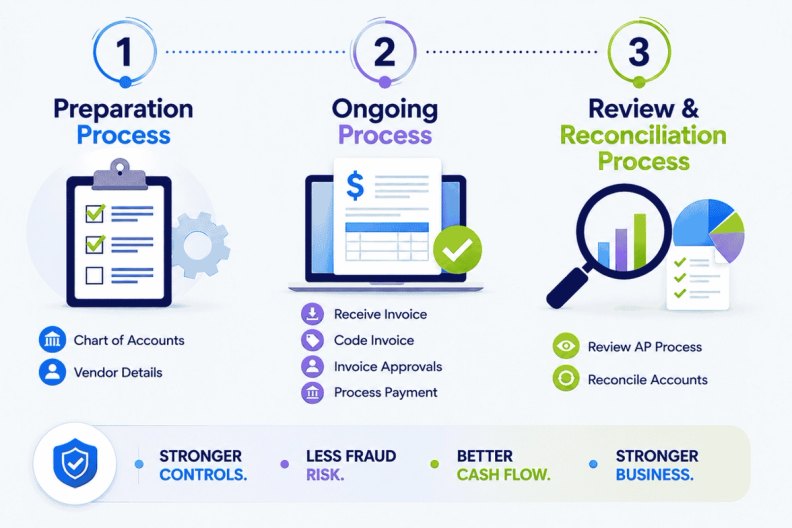
Step 1. Preparation process
Consider your chart of accounts: A chart of accounts is a structure used to organize and record your accounting transactions. When a bill is entered into Accounts Payable, there is always another side of that transaction, usually an expense account, identifying what the expense is for.
We have a chart of accounts template you can follow, if you don’t already have one in place. We also have instructions on how to set it up in QuickBooks Online.
Track important vendor details: To make paying your vendors easier, their information should be gathered and recorded. Once you save a vendor’s important contact information and payment information, it makes paying them in the future faster and easier.
Centralizing invoice payments is crucial for gaining a clear overview of company expenditures and preventing fraud. By handling all company spend from one place and using automation software, you can streamline invoice payments for your AP team.
Step 2. Ongoing process
Receive invoice: After requesting or receiving product or services from a vendor, they send you an invoice to request payment. This invoice will include any relevant information necessary to make a payment.
Code invoice: Once you have the invoice, you code it and process it for payment. Coding an invoice includes entering the necessary payment information, such as the amount due and the date it is due. It is also when you specify what account this transaction will be categorized under and assign approvers to double check the information.
Invoice approval: Once an invoice is coded, any specified approvers review the information to ensure it is entered correctly before payment is initiated. Clear policies and procedures around invoice approval reduce unauthorized and unnecessary purchases and make timely payments, ensuring efficiency.
Process payment: Once the accuracy of your invoice is verified, payment can be initiated to the vendor.
Step 3. Review and reconciliation process
Review the AP process: Next, you update your books to reflect the latest payment made to your vendors. This is also a perfect time to review your chart of accounts, vendor information, or any other relevant information and update it, if needed.
Additionally, reviewing the entire accounts payable cycle for accuracy and efficiency is crucial. AP aging reports can be very useful in helping you identify any vendors with balances that seem off.
Reconcile accounts: Reconcile your bank or credit card accounts regularly (usually monthly) to make sure that all payments have been entered, processed, and completed successfully. Any payments made pertaining to bills should be applied directly against those bills. Reconciling your accounts allows you to find any errors or problems that may have occurred during the AP process, duplicates that may have been entered, or payments that were never correctly applied.
If you are using an external AP system like Bill or Veem, you will also want to verify that their vendor balances match the individual vendor balances found in your accounting software AND that total AP balances match.
The accounts payable process can improve your business’s workflow in many ways:
- Streamlining the expense process
- Reducing errors
- Preventing fraud
- Offering insight into how to optimize your spending efficiency
If you need help with this, our 7 Best Practices to Streamline Your Accounts Payable Process download lays out concrete steps for tightening up your AP controls.
Depending on your accounting setup, you can manage it with:
- An in-house accounts payable department dedicated to AP.
- Your general bookkeeping and accounting team.
- An outside accounting firm (ex. LedgerGurus) running it for you.
Frequently asked questions
What’s the difference between accounts payable and accounts receivable?
Accounts payable is money your company owes to its vendors, an outgoing liability on the balance sheet. Accounts receivable is money you expect to receive from customers, an incoming asset. They’re a mirror of the same relationship, just looked at from opposite directions.
Are bills and invoices the same thing?
Not exactly, though the terms get mixed up often. An invoice is money you expect to receive, while a bill is money you owe and need to pay. Vendors label what they send you as an invoice because that’s what it is to them, but to your business it’s a bill.
What does a basic accounts payable process look like?
It starts with placing a purchase order with a vendor, then recording the bill once it arrives. From there, you initiate payment before the due date and record that payment against the original bill to bring your accounts payable back down.
Why does a strong AP process matter for fraud prevention?
AP is one of the highest points of fraud risk in a business because it’s easy for money to slip through without good controls. A well-designed process uses checks and balances so no single person has total control over the company’s money. Clear approval policies also cut down on unauthorized or unnecessary purchases.
Who should manage accounts payable for my business?
It depends on your setup. It might fall to an in-house AP department or your general bookkeeping team, or you might hire an outside accounting firm like LedgerGurus to handle it for you.
Let us handle your accounts payable for you
We provide full accounting services for ecommerce businesses, including a dedicated AP team that makes sure every invoice gets entered accurately and paid on time.
