


Most guides on this topic treat cash and accrual accounting as a single, permanent decision. Pick one and stick with it. In practice, almost no ecommerce business works that way. You'll start cash-basis because it's simple, then get pulled toward accrual one piece at a time, as inventory timing, seasonal cash flow, or a new investor's expectations force the issue. This guide follows a fictional company, Bathtime Ducky Co., through each of those pushes, so you can see exactly which stage you're in right now and what's likely to trigger next.
Cash or accrual? It's actually a spectrum
You have a business, and you want to know how it's doing. Once a year, you need to file taxes. You might be weighing cash accounting against accrual, and wondering how complicated it would be to switch later. The reality for most companies is that they use a combination of both, and move along the spectrum from cash toward accrual as the business matures. That raises three real questions:
- What does the spectrum between cash-basis and accrual-basis accounting actually look like?
- What pain points push a company to adopt more accrual processes?
- How will you know when your company needs to move further along it?
Here's a quick way to picture it.
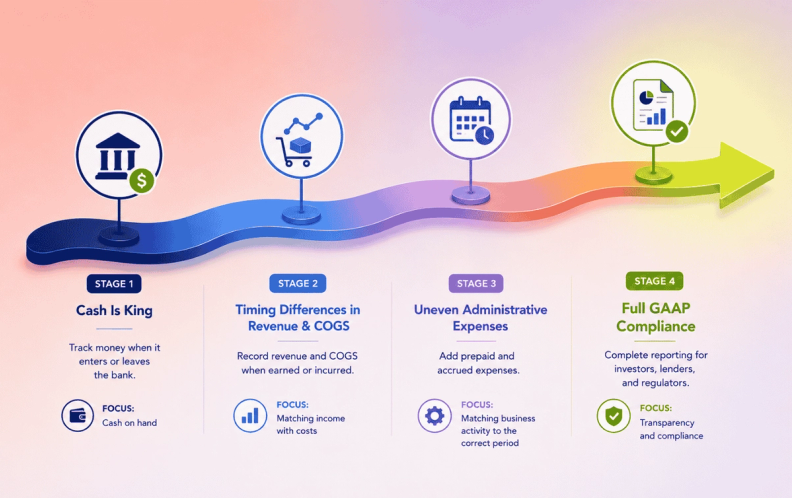
To illustrate how a company moves through the spectrum, we'll follow a fictional company, Bathtime Ducky Co., from launch to IPO.
Defining cash-basis and accrual-basis accounting
For clarity: cash-basis accounting means recording revenue when cash hits the bank account and expenses when cash leaves it. Accrual-basis accounting means recording revenue and expenses, when they're earned or incurred, regardless of when cash actually moves.
Who typically stays strictly cash-basis? Most often, brand-new companies focused on growing sales and covering expenses, or companies that have run stably and predictably for years with little structural change.
On the other end, who's required to use full GAAP accounting? Companies making $25 million in sales over a three-year period, or companies that are publicly traded.
Stage 1: Cash is king
Start-ups
Companies in start-up phase almost overwhelmingly track finances on a cash basis. Revenue may be little or nonexistent, and the main concern is keeping enough cash in the bank to pay bills as they come due.
The number startups watch most closely is their bank balance. They're not usually ready to track financial data at a more complex level, and the IRS is perfectly fine with cash-basis filing as long as the company tracks what it sells and spends each year.
Example: Brand-new startup Bathtime Ducky Co. launched its first few products in March on ecommerce platforms. The company hoped its product would gain popularity before the Christmas selling season, but soon found its first months of sales barely covered advertising costs. Bathtime Ducky Co. wanted to spend time reviewing profit and loss statements, but instead had to focus entirely on increasing sales just to survive until Christmas. So, the owners settled on watching the bank account balance, sometimes contributing personal funds to stay afloat.
Mature companies with no seasonal variation
Other companies find they're perfectly comfortable with a 100% cash model year after year. These companies, like D'oh! Doughnuts, may have very little seasonality. They collect cash up front for their product and pay cash up front for supplies. Because little changes week to week, they don't need to plan for higher cash needs in certain periods, and because they always collect cash up front, they always know what they have on hand. During inflationary periods, they may see ingredient, labor, and rent costs rise and raise their prices accordingly, but otherwise, month to month stays fairly steady.
Stage 2: Timing differences in revenue and COGS
What happens to a company with uneven sales due to seasonality, or one that pays for supplies in one month while using them over several? While stable, unchanging companies like D'oh! Doughnuts may have their needs met by cash basis, growing or maturing companies often start feeling some real pain points:
- Selling on ecommerce platforms and wanting to show gross revenue, not revenue net of fees.
- Preordering and paying for new products, then receiving them months later.
- Customers who receive product but don't pay for several weeks.
- Inventory that arrives all at once but sells over several months.
Companies facing these start recording revenue on an accrual basis, often followed by COGS, even while everything else stays cash-basis. Cash-basis accounting stops showing the full picture, and the natural first step toward better accounting is moving sales onto an accrual basis.
Bathtime Ducky Co's revenue challenges
Bathtime Ducky Co. has grown sales enough to break even, and may decide to start recording gross sales and gross expenses, the way most ecommerce accounting eventually requires. The company also starts selling wholesale, which means collecting payments from clients on credit and payment terms.
Recording revenue on an accrual basis gives Bathtime Ducky Co. a clearer sense of when sales are actually happening, regardless of when cash arrives. They start tracking COGS on an accrual basis too, for a more accurate picture of what their sales actually cost to produce, regardless of when cash leaves the company for inventory.
Stage 3: Uneven administrative expenses
Once a company is recording revenue and COGS on an accrual basis, tracking profitability accurately often gets harder, usually because administrative expenses are still cash-basis. Annual software renewals or other prepaid expenses can land as one large payment in a single month with nothing comparable for months afterward.
That makes month-to-month financials hard to compare, and makes setting monthly sales targets difficult from a cash-planning perspective, since management doesn't have a reliable read on upcoming expenses either. The next move is recording prepaid and accrued expenses, recognizing expenses in the period they're actually used, regardless of when they're paid.
Bathtime Ducky Co's software challenges
Bathtime Ducky Co. keeps growing. With revenue and COGS now recorded in the right period, management wants its software subscription expenses spread monthly over the life of each subscription, rather than recorded in one lump sum when purchased.
Stage 4: Full GAAP compliance
Once a company records revenue, COGS, and most or all administrative expenses on an accrual basis, it often finds itself with investors or debtholders who want financial statements and require full GAAP compliance.
At that point, the company implements whatever GAAP training or processes it's still missing, and may need to bring in an accounting firm for a review or audit. It may also simply have crossed the threshold on its own: $25 million in sales over three years, or going public. Both trigger the same requirement.
Bathtime Ducky Co. on the stock exchange
If rapid growth eventually leads Bathtime Ducky Co. toward an IPO, it will have already worked to prepare for full GAAP accounting, and will shift focus to polishing its financial statement presentation to the level investors expect.
For a complete list of ecommerce accounting best practices, and which phase to focus on them in, download our Essential Ecommerce Bookkeeping Checklist.
Frequently asked questions
What's the actual difference between cash-basis and accrual-basis accounting?
Cash-basis records revenue and expenses when cash actually moves in or out of the bank. Accrual-basis, following GAAP, records them when they're earned or incurred, regardless of when the cash shows up.
Do I have to pick one method and stick with it forever?
No. Almost no company is purely one or the other. Most move gradually from cash toward accrual as they grow, often adopting accrual for revenue and COGS first, and administrative expenses later.
What's usually the first accrual step a growing business takes?
Recording revenue on an accrual basis, typically triggered by seasonality, preorders, delayed customer payments, or inventory that arrives all at once but sells over months. COGS often follows shortly after.
When is a company legally required to use full accrual (GAAP) accounting?
Once it crosses $25 million in sales over a three-year period or becomes publicly traded. Investors or debtholders may also require it earlier as a condition of funding.
How do I know it's time to move further along the spectrum?
Watch for the pain points at each stage. Seasonality or timing mismatches push you toward accrual revenue and COGS. Uneven administrative expenses push you toward accrued and prepaid expenses. And outside capital or public trading push you toward full GAAP.
Let us help you find the right spot on the spectrum
Most companies do not use strictly cash or strictly accrual accounting. They fall somewhere on a sliding scale, and move along it as their need for more accurate information or more rigorous reporting grows. Wherever your business sits right now, we can help you figure out the right next step.
