

Article
How to Identify Your Most Profitable Revenue Opportunities
Finding real revenue opportunities starts with contribution margin and profit velocity, not top-line sales. This covers how to segment revenue meaningfully.
Topic hub
Articles, videos, podcasts and webinars on Strategy for ecommerce brands.
Finding real revenue opportunities starts with contribution margin and profit velocity, not top-line sales. This covers how to segment revenue meaningfully.

Most owners don't think about their exit until it's too late to fix what's broken. This covers four areas to focus on now so you're ready whenever you exit.
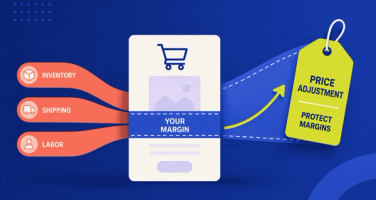
Inflation quietly erodes margins through rising inventory, shipping, and labor costs. This covers how to spot the impact, and three pricing approaches.

Prepping an ecommerce business for sale 12-18 months out can add real dollars to its final value. This covers six areas to focus on before you list it.

Profitability, not growth, keeps a business alive through a downturn. This covers a five-part financial health check to see where you stand and what's next.

Ecommerce trends shift fast. Here are the ones worth watching this year, and how each one affects your bottom line.

An asset based valuation undersells an ecommerce brand, because manufacturing and fulfillment are outsourced and there is little to count. The income approach is the most accurate, and it runs on EBITDA (earnings before interest, taxes, depreciation, and amortization): two to four times on a conservative view, four to eight on a liberal one. Stephen Brown covers the factors that decide where in that range you land, and why what a buyer will pay is the number that counts.

AI companies run on venture capital, which means the price you pay is not the cost of the product. Stephen Brown walks Stacy Walker through what happens when that equalizes: base subscriptions plus token consumption, already visible in Claude's limits, GitHub Copilot's June shift, and Gorgias. He covers what tokens are, why GPU compute changed the economics, and why matching cheaper models to simpler work is about to matter. He finishes with how to spot the creep before it compounds.

Guest: Bret Mitchell, EOS Implementer at EOS Worldwide. He started his career consulting Fortune 500 companies in New York, later sat on the leadership team at Purple and held the chief merchandising officer seat at Overstock.com, and now helps leadership teams across industries implement EOS.

Mark Lupton returns to argue that business value isn't something you find out at a sale. He and Stephen Brown work through judging your own business the way an acquirer would: opportunity on one side, risk on the other, with proof and protection as the evidence that bridges them. They also apply Porter's Five Forces to channel concentration, explain why growth that outruns your own cash flow costs you at valuation, and separate intrinsic value from market value.
Merchant cash advances quote a fee, not a rate. A 10% fee repaid over four months is closer to 42% APR, and most brands never do that math. Stephen Brown and David Segal of Highbeam cover what LedgerGurus customer data shows about margins and cash, why inventory problems are operational rather than financial, how to negotiate supplier terms before borrowing, and where AI is producing real results in finance work.

Ten calls for the year ahead, delivered in 25 minutes. Stephen Brown argues tariffs have peaked, interest rates split into winners and losers depending on what your debt is tied to, and inflation stays sticky enough that annual price reviews are now table stakes. His most bullish call is AI: shopping, checkout, and eventually advertising. Lauren Maillard covers the tax provisions worth planning around.
Tariffs directly raise COGS and squeeze margins, and they're specifically named as one of the current pressures (alongside supply chain disruption and rising holding costs) making inventory management more urgent in 2026. Response strategies include diversifying manufacturing across countries, negotiating DDP (delivery duty paid) terms so suppliers absorb the tariff burden, using bonded warehouses to defer tariffs until goods actually sell, and modeling scenarios with a dedicated Tariff Impact Calculator before deciding whether to raise prices.
Read: Why inventory optimization matters nowFounders who tried dumping financial data into general AI tools have had mixed results, inconsistent responses, expensive for basic queries, and hard to audit or trace. What's actually working is purpose-built AI trained on specific financial workflows (connected to QuickBooks, banking, inventory data) that writes repeatable, auditable code rather than generating one-off answers each time, so the same process runs reliably whether you check it Monday or Friday.
Read: Where AI fits in cash flow planningYes, unambiguously. Clean, accurate books are described as "the single biggest thing" you can do to increase your sale price, they prove your numbers are trustworthy, strengthen your negotiating position, and directly support a higher valuation. Messy books make buyers nervous and hurt you at the table, even if the underlying business is healthy.
Read: Why clean books raise your sale priceWe use cookies to improve your experience and to measure how our site and ads perform.Read our Cookie Policy