

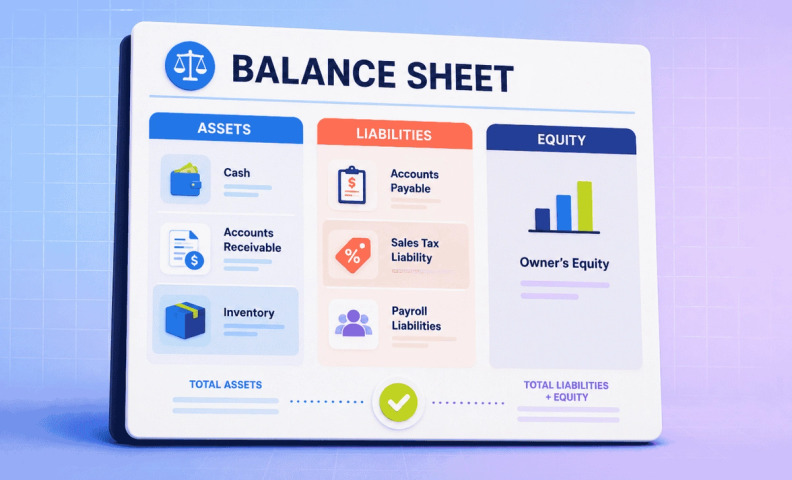
An ecommerce balance sheet looks like any other balance sheet at first glance, assets, liabilities, and equity, but a couple of accounts behave differently once inventory and multi-state sales tax enter the picture. This post focuses on the two that trip up ecommerce businesses most: sales tax liability and inventory balance.
You can also watch How to Read and Analyze Your Ecommerce Balance Sheet that walks through how to read your ecommerce balance sheet.
What makes an ecommerce balance sheet different?
Your balance sheet is built on either accrual or cash accounting, and as an ecommerce company, you want it to reflect your true financial standing, not just what's sitting in your bank account.
Why cash vs. accrual accounting matters here
Cash accounting records a transaction when money actually changes hands. You buy something, cash goes out. You make a sale, cash comes in. Accrual accounting records the transaction when it's earned or incurred, whether or not the cash has moved yet. For ecommerce businesses, that difference shows up constantly. You buy inventory on payment terms, or you collect sales tax from a customer today that you won't remit to the state for weeks or months.
Under cash accounting, none of that pending activity shows up on your balance sheet until the cash moves. That means a business can look flush with cash while actually sitting on unpaid bills, unremitted sales tax, and unpaid payroll liabilities it hasn't accounted for yet. Accrual accounting captures all of that as it happens, giving you a balance sheet that reflects what you actually owe and are actually owed, not just what's currently in the bank.
This is exactly why a healthy-looking cash balance can be misleading. If a chunk of it is collected sales tax or payroll withholding sitting there temporarily, it was never yours to spend in the first place. Setting aside a separate bank account for those funds helps, but the real fix is making sure your books are accruing those liabilities correctly so you're not caught off guard when they come due.
For the full breakdown of both methods and when each makes sense, see our guides to cash vs. accrual accounting and choosing the right method for your business.
Beyond cash vs. accrual accounting, two balance sheet accounts deserve special attention: sales tax liability and inventory balance.
Getting your sales tax liability account right
Sales tax compliance is more complicated for ecommerce businesses because of economic nexus. Knowing exactly where you have nexus is what keeps your sales tax liability accurate, not overstated or understated.
A balance sheet showing zero sales tax activity should raise a red flag, virtually every business has economic nexus in at least one state. An incorrect sales tax liability account can also mean penalties or additional fees.
The sales tax liability account is a short-term liability, since funds typically need to be remitted within a year. It captures the total sales tax you've collected from customers on behalf of a taxing authority. The balance grows as you collect and shrinks as you remit. For the exact journal entries behind it, see our full guide.
If you remit sales tax across many jurisdictions, consider breaking your liability into sub-accounts by state, county, or local government. It makes each one easier to track individually.
Getting your inventory balance right
Inventory is one of the most important parts of an ecommerce balance sheet, and knowing the right numbers makes all the difference.
To check whether your inventory balance is accurate, ask two basic questions:
- Is there a balance in the account at all?
- If so, does it actually move as you buy and sell?
If there's no balance where there should be one, or the number isn't changing despite consistent purchasing and selling, that's a clear sign something's off in how inventory is being recorded, often one of these causes of stock discrepancies.
Your inventory balance is an asset that increases when you buy inventory and decreases when you sell it and relieve it through COGS. Getting this number wrong skews more than your balance sheet. A balance that's too low understates your assets and overstates your COGS, while too high does the reverse. Either way, it gives investors, lenders, and you an inaccurate read on your company's financial health.
Putting it all together
Getting your sales tax liability and inventory balance accounts right is what separates a balance sheet you can trust from one that just looks complete. If you're not confident both are accurate, that's worth a closer look before you make decisions based on what they're telling you.
We've also created an in-depth articles on reading your ecommerce cash flow statement and how to understand your income statement, natural next steps once your balance sheet is in order.
Frequently asked questions
Why does my balance sheet show more cash than I feel like I actually have?
Because collected sales tax and payroll liabilities sitting in your bank account aren't yours to keep. If your balance sheet doesn't set that money apart, it can make you feel wealthier than you actually are.
What does it mean if my balance sheet shows zero sales tax liability?
It's a red flag. Almost every ecommerce business has economic nexus somewhere, so a zero balance usually means sales tax isn't being tracked correctly, not that you genuinely owe nothing.
Should I break my sales tax liability into separate sub-accounts?
If you're remitting to multiple states, counties, or local jurisdictions, yes. Breaking the liability into smaller sub-accounts makes it much easier to track what's owed to each authority individually.
What does it mean if my inventory balance isn't changing?
If you're actively buying and selling inventory but your balance sheet shows a static number, something's wrong with how inventory is being recorded. It should rise and fall with your purchases and sales.
What happens if my inventory balance is too low or too high?
Either way, it skews your numbers. Too low understates your assets and overstates your COGS; too high does the opposite. Both give you (and outside parties like investors or lenders) an inaccurate read on your financial health.
What's the difference between cash and accrual accounting on a balance sheet?
Cash accounting only reflects money that's actually moved, while accrual accounting also captures unpaid bills and uncollected revenue, giving you a more complete, accurate picture of where your business actually stands.
Get your ecommerce balance sheet right
Sales tax liability and inventory balance are two of the trickiest accounts on an ecommerce balance sheet, and getting them wrong can quietly distort your entire financial picture.
If you'd rather have experts make sure both are accurate, our ecommerce accounting team can help.
