

It’s a question you may have asked yourself many times: Where’s the money going?
Understanding the ins and outs of where the money is going (the cash flow) is a common challenge among business owners. Why? Most people just don’t get excited staring at numbers on a screen (except for number nerds like us!) and often neglect evaluating their cash flow.
Looking at the financials of a business can feel confusing and downright overwhelming.
- How much cash will I have next month?
- Can I afford to invest in more inventory, a new warehouse manager, or additional marketing?
- Where’s the money really going?
As accounting experts, we know the power of being literate in the language of accounting. It’s a vitally important skill for business owners in making financially sound and profitable decisions.
A business owner who can foresee a cash dip in six months has a lot more financial options than one who realizes the truth two weeks out. Knowledge IS power. And we want to empower you to understand your ecommerce cash flow statement.
So, let’s start with the basics.
What is cash flow (and why it's different from profit)
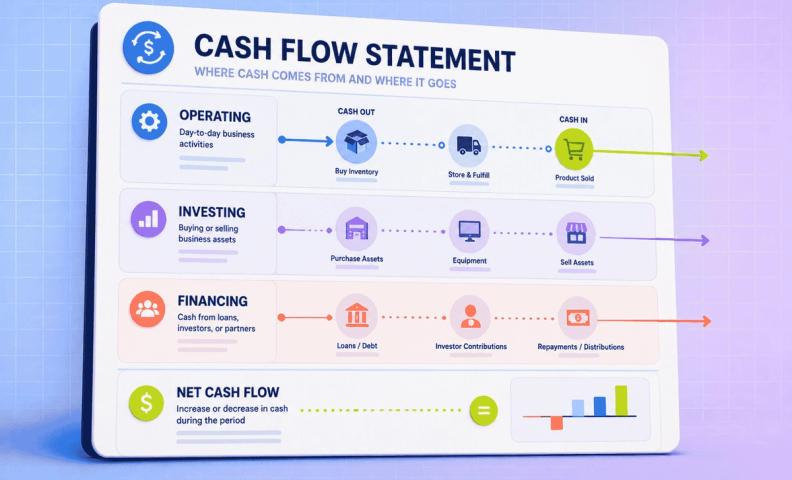
In its simplest terms, cash flow equates to the net amount of cash going in and out of your business during a specific time (e.g., year). There are three types of cash flow:
- Operating: Cash flow as a result of your business activities (buying and selling product, overhead, payroll, marketing)
- Investing: Cash flow as a result of buying and selling your business assets (a warehouse, machinery, etc.)
- Financing: Cash flow that comes from partners, investors, or outside lenders (loans, equity contributions, etc.)
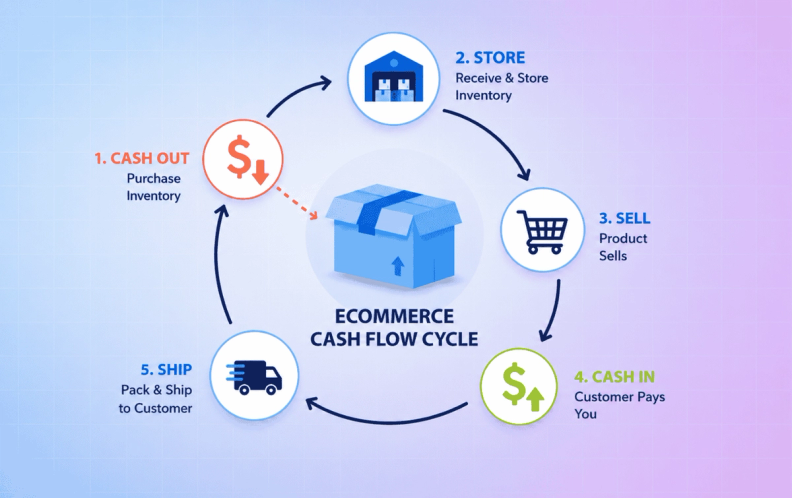
The movement of cash can be broken down into what’s called the cash flow cycle, which is one of the most important things an ecommerce business owner can learn to survive. This is what it looks like:
- Order and purchase product → CASH OUT
- Product shipped, received, and stored
- Product sold → CASH IN
We also have this handy visual which shows the cycle:
Knowing it can take months for this cycle to complete, it becomes really important to plan strategically for the anticipated cash dips and increases. This is where a cash flow statement can become your best friend.
The cash flow statement is a financial statement built with information from both your profit and loss statement (or income statement) and balance sheet. It essentially shows the movement of cash money within your business.
Why ecommerce businesses need a cash flow statement
Understanding the fluctuation of cash is essential to ensure you can complete your cash flow cycle and stay profitable. Your statement gives you visibility in where the money is really coming and going. It gives you what we call operational integrity, which is making sure the operational activities of your business are cash positive (as opposed to cash negative), so you don’t have to rely on outside sources of cash to stay afloat.
Especially for ecommerce business owners, your cash flow statement is a fundamental tool to knowing when to purchase new inventory. Just like Goldilocks, you don’t want too much or too little inventory. You want to hit the mark just right to save costs and maximize profit. And timing is key. For example, seeing the statement can help you determine when is the best time to reorder product for anticipated big sales seasons, like Christmas.
On the topic of inventory specifically, be sure to check out our video How to Calculate and Optimize Inventory Turnover where we explain the metrics of managing your inventory.
Direct vs. indirect method: Which should you use?
In the accounting world, there are two main types of cash flow statements:
- Direct method: This method looks at the cash that is brought in by sales and the cash that is paid out for expenses.
- Indirect method: This method looks at net income first and then adds or subtracts all the cash impact from different operating activities (depreciation, accounts receivable, inventory, supplies, wages, taxes, etc.).
Here's what that difference looks like in practice. Say your business had $50,000 in net income last month.
Direct method: You'd build the statement from the ground up, cash collected from customers ($180,000), minus cash paid to suppliers ($95,000), minus cash paid for payroll and overhead ($35,000), arriving at $50,000 in operating cash flow. Straightforward to read, but you need clean, itemized cash records to build it this way.
Indirect method: You'd start with that same $50,000 net income, then adjust for non-cash items and timing differences, adding back $8,000 in depreciation (a real expense on your P&L, but not actual cash leaving your account), then adjusting for a $12,000 increase in inventory (cash that went out to buy stock that hasn't sold yet) and a $6,000 increase in accounts payable (bills you owe but haven't paid yet, so the cash hasn't left). Net result: the same $50,000 in net income becomes $52,000 in actual operating cash flow, once you account for the cash that moved (or didn't) around it.
Both methods should land on the same operating cash flow number by the time you're done, they just get there differently. The indirect method's real advantage is that it shows you why your cash position differs from your net income, which is exactly the kind of insight that matters most for ecommerce businesses juggling inventory purchases and payment timing.
While the direct method is conceptually easier to understand, it can be more challenging to implement depending on how complex your systems are for tracking sales and expense data. For this reason, we recommend focusing on the indirect method for two reasons:
- It is the default structure used in QuickBooks.
- It shows all the pieces for evaluating your net income, which is another vital data point for making sound business decisions.
The real payoff of healthy cash flow
If it’s still a little murky why you need to have a cash flow statement, let’s list a couple more reasons:
Healthy cash flow = Less stress
Constant financial stress can genuinely kill a business, and negative cash flow is one of the biggest sources of that stress, always working hard but never quite getting ahead. Positive cash flow feels like the opposite: the same work, but with room to breathe.
When you know where your money is coming from and where it's going, you're making decisions from a position of knowledge instead of guesswork. That confidence and predictability directly counteract the stress that comes with not knowing, and they're exactly what a cash flow statement gives you.
Healthy cash flow = Increased opportunities
When you’re looking to expand your business, you have to know your cash flow. Positive cash flow opens opportunities to invest in more inventory or infrastructure, engage in new partnerships, or ramp up your marketing. Perhaps you’ve kept these decisions on the backburner for a while because the cash simply is not there to expand? If that’s you, then use your cash flow statement to help you know what you can do. Remember, this information will make you a better business owner and is one of the most powerful tools to lead a successful business!
Frequently asked question
What's the difference between cash flow and profit?
Profit (net income) reflects revenue minus expenses on paper, including non-cash items like depreciation and timing differences. Cash flow reflects money that's actually moved in and out of your bank account. A business can be profitable and still run out of cash, which is exactly why both numbers matter.
What are the three types of cash flow?
Operating (day-to-day business activity like sales, payroll, and overhead), investing (buying or selling business assets like a warehouse or equipment), and financing (money from loans, investors, or partners).
Why does the ecommerce cash flow cycle take so long?
Because cash goes out when you order and pay for inventory, but doesn't come back in until that inventory is shipped, received, stored, and finally sold, a cycle that can take months depending on your supply chain.
Should I use the direct or indirect method for my cash flow statement?
The indirect method, for most ecommerce businesses. It's the default structure in QuickBooks, and it shows your net income alongside your cash position, giving you two important data points at once.
What is a cash flow statement actually built from?
Your Profit and Loss Statement and your Balance Sheet together. It translates both into a clear picture of how cash is actually moving through your business.
What's the real payoff of monitoring cash flow closely?
Less stress and more opportunity. Knowing your cash position lets you plan confidently for inventory purchases, hiring, and marketing, instead of reacting to cash shortfalls after they've already happened.
Get help understanding your cash flow
Seeing your cash flow clearly is one of the most powerful tools for running a healthy, growing business. If you'd rather have experts build and interpret your cash flow statement for you, we can help.
