

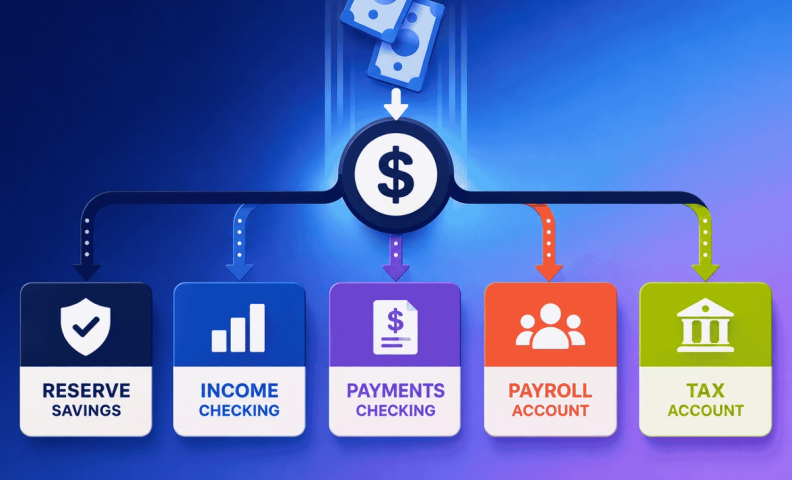
Let’s talk about something that can significantly impact your financial health and organization: how many bank accounts your business should have.
Too often businesses do everything from a single account with a single bank, but there are better ways.
Think about it: mixing expenses, savings, and sales tax money in one account is like trying to keep track of your grocery, rent, and vacation funds all in one wallet. Sounds messy, right?
In this blog, we’re going to dive into the ideal number of bank accounts every business owner should consider having to streamline business finances and avoid confusion.
Why have multiple business bank accounts?
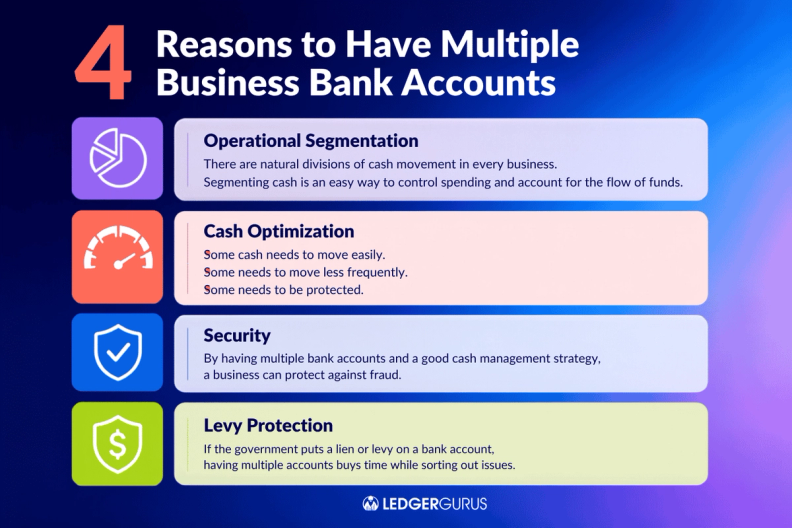
There are several reasons to have multiple bank accounts:
- Operational segmentation
- Cash optimization
- Security
- Levy protection
Operational segmentation
There are natural divisions of cash movement in every business:
- Bills or accounts payable
- Payroll
- Accounts receivable or income from credit cards / merchant accounts
- Taxes
Segmenting cash can be an easy way to control spending and account for the flow of funds.
Cash optimization
Some cash needs to move in and out easily, some moves less frequently, and some needs to be protected. Different accounts can provide different levels of control and interest.
Maximizing the value of idle cash is worth prioritizing, since reserve funds sitting in a low-interest account are a real, ongoing cost.
Security
Knowing a bank account number, routing number, business name, and address is often enough for someone to attempt fraud against you. This can happen through fraudulent checks (it’s easy to order a checkbook online) or fraudulent ACH (electronic payments).
By having multiple bank accounts and a good cash management strategy, a small business owner can better protect against fraud.
Levy protection
A government agency can put a lien or levy on a business account if taxes are determined to be owed. With an IRS levy, this can mean funds are frozen.
States can take similar moves. They will try to lock up all accounts, but there are some they know about already: the payroll or sales tax accounts. Having multiple accounts may buy some time while sorting out the issues.
You should have at least three key bank accounts
With the reasons established, we now must answer the question: how many bank accounts should a business have?
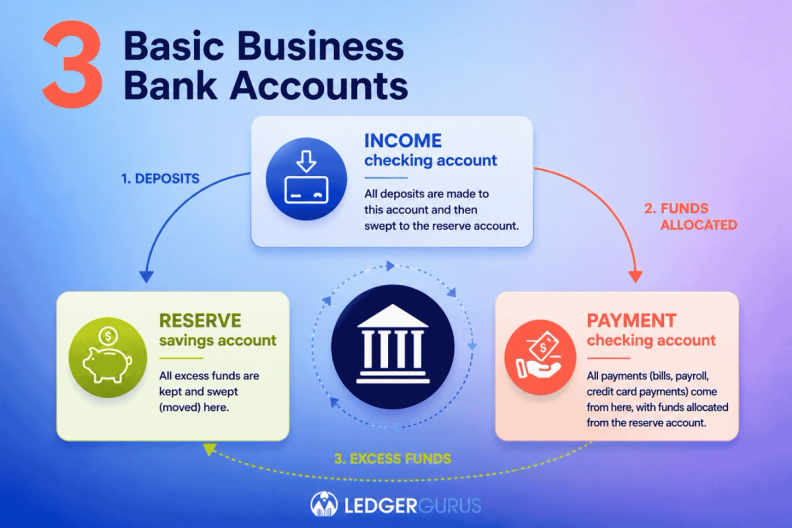
Let’s start with a basic strategy where a business has three separate accounts:
- Reserve savings account: All excess funds are kept and swept (moved) here. The account number should never be given out to protect the funds.
- Income checking account: All deposits are made to this account and then swept to the reserve account.
- Payment checking account: All payments (bills, payroll, credit card payments) come from here, with funds allocated from the reserve account.
You should have accounts in multiple banks
In addition to having multiple bank accounts, a business should consider having multiple banks. Having multiple business checking accounts at more than one business bank can be valuable for a few reasons:
- FDIC insurance
- Business continuity
- Interest maximization
Exploring some of the best business online banking solutions is a wise move to ensure the safety of your funds. These platforms provide added security features like two-factor authentication and robust fraud detection systems.
FDIC insurance
There are several ways to protect deposits above the $250,000 FDIC insured limit. One of those ways is by simply distributing funds across multiple banks. This will allow you to maximize the FDIC insurance limit.
Business continuity
Banks occasionally fail, as we learned in 2023. Even if deposits are FDIC insured, a bank failure can make access to and movement of funds difficult. By using multiple banks, one bank’s issues don’t paralyze a business.
Interest maximization
For reserve accounts, it is best to get the maximum interest on those funds. Find banks with high yield savings accounts and put reserves there.
At minimum, accounts in two banks is ideal. More than two is likely unnecessary until a business gets larger.
Moving from 3 to many bank accounts
As a business grows, it can make sense to break out the three accounts into multiple accounts. This can be for different reasons, but here are some approaches to consider:
- Payroll checking account: Break out payroll separately from payments and fund it around payrolls. Any issues with payroll taxes become isolated.
- Tax reserve savings account: It’s a good idea to have a tax reserve account. This can be a fixed amount of sales tax and/or calculated amount of income tax based on profits.
One can go much further depending on the type of business and purpose of funds. Splitting accounts across banks should consider the benefits of banks. Savings funds should be in banks with the best interest. Having payroll checking in a separate bank can be a good firewall should any issues arise.
Profit First bank accounts
Mike Michalowicz's book Profit First lays out a more advanced approach to cash management, built entirely around bank accounts. Here's a quick summary of how it works:
- Income checking account: All deposits are made here, then allocated to the subsequent accounts.
- Profit checking account: This is a percentage of income using the Profit First methodology.
- Owner’s Compensation checking account: This is a dedicated amount for payroll or distributions, depending on business type.
- Tax checking account: This is a calculated amount to cover taxes when they are due.
- OPEX (operating expenses) checking account: This is what is left over to run the business.
Profit First also recommends moving funds from the Profit checking and Tax checking accounts to corresponding savings accounts until those are paid out.
There is so much more to Profit First than these 5-7 accounts, so go check out the book for yourself. It’s a great read for owners of businesses of any size.
Multiple bank accounts for an ecommerce business
LedgerGurus is specialized in ecommerce accounting, so we recommend some best practices to consider when it comes to bank accounts. Considerations include:
- Sales tax: Every ecommerce business is dealing with sales tax, and it could make sense to sweep collected sales tax to a checking and/or savings account until it is time to pay the different government agencies.
- Income: Revenue for ecommerce comes from merchant services like PayPal, Stripe, numerous payment processors and online platforms like Shopify, Amazon, etc. It could make sense to have dedicated accounts by channel as a business gets large.
An ecommerce business bank account structure could look something like this:
- Revenue checking account: Sweep funds to the general reserve savings account and sales tax savings account.
- Sales tax savings account: This is a calculated amount that can be accounted for from sales reports.
- Sales tax checking account: Funds from the sales tax savings account are moved here when it’s time to pay the appropriate agency.
- General reserve savings account: This can be an account from which funds are moved into different special purpose accounts. If a business is profitable, this account may get large and should maximize interest and FDIC protection.
- Payments checking account: All credit card payments, electronic payments, and checks should come from this account. Fund what is needed for a month, and nothing more.
- Payroll checking account: Connect the payroll system to this and fund it for a month of payroll at most.
- Income tax savings account: Using Profit First, calculate the tax that will need to be paid out, and hold it here until annual or quarterly payments are needed.
- Profit savings account: Profit First is smart in that profits should be allocated here. Draw from this account to the owner’s compensation account on a regular basis.
That’s 8 accounts: 3 savings and 5 checking.
Make sure to look at bank fee and minimum balance structures as many larger banks like to take out fees when there aren’t minimum balances.
Could you get away with more or less? Yes, it all depends on your approach.
When you go to switch business bank accounts, make sure you’re thinking of everything involved. Click here to read 10 Steps for Switching Business Bank Accounts.
How to manage cash across accounts
With multiple accounts, there is some math and movement of money. The math isn’t complex, and a good accountant or bookkeeper can help with the allocation of funds.
Next, you need to come up with a money movement strategy.
Here at LedgerGurus, we sweep income weekly and reallocate to other accounts monthly.
Plan on moving money at least monthly and not more than weekly. It doesn’t take long if you have a formula. Get the formula right and even consider a buffer on payments as it’s easy to have unexpected payments from time to time.
In terms of movement of funds, there are two approaches:
- Same bank: Within a bank, movement is usually easy. Most banks have easy, and often instant, methods of moving funds from accounts within the bank under a single business owner.
- Bank to bank: There are low to no cost ways to move funds from bank to bank. These tools take minutes to use once setup, and the timing can be same day to a few days, depending on the approach that is used. Wires are fast and expensive, and ACH takes a few days and is cheap.
Frequently asked questions
What are the three basic bank accounts every business should have?
A reserve savings account, an income checking account, and a payment checking account. Deposits land in the income account and get swept to reserve savings, while every outgoing payment, bills, payroll, and credit card payments, comes out of the payment account, funded from reserve as needed.
Why should a business use more than one bank, not just more than one account?
Splitting accounts across at least two banks protects deposits beyond the $250,000 FDIC insurance limit, keeps the business running if one bank fails like several did in 2023, and lets you put reserve funds in whichever bank offers the best interest rate.
Can a government levy freeze all of a business's bank accounts at once?
An IRS or state levy can freeze funds, but agencies typically already know about the accounts tied to payroll or sales tax. Having money spread across multiple accounts and banks can buy time to sort out the issue instead of having everything locked up at once.
What is the Profit First method for structuring bank accounts?
Profit First splits incoming deposits across five to seven dedicated accounts, income, profit, owner's compensation, tax, and operating expenses, so profit and taxes get set aside automatically before the money can be spent on anything else.
How many bank accounts does an ecommerce business actually need?
A common ecommerce structure lands around eight accounts, three savings and five checking, covering revenue, sales tax, general reserve, payments, payroll, income tax, and profit. That said, the exact number depends on the business, and a bookkeeper can help design a formula for sweeping funds between them monthly.
Let's help you put this into practice
Knowing how many accounts to have is one thing. Actually setting up the sweeps, allocations, and monthly reconciliation is another. That's where an ecommerce-specialized accountant earns their keep.
LedgerGurus follows the Profit First methodology in how we run our own finances, and we help ecommerce brands build and manage the same kind of multi-account structure, so you can focus on growing the business instead of tracking cash.
