

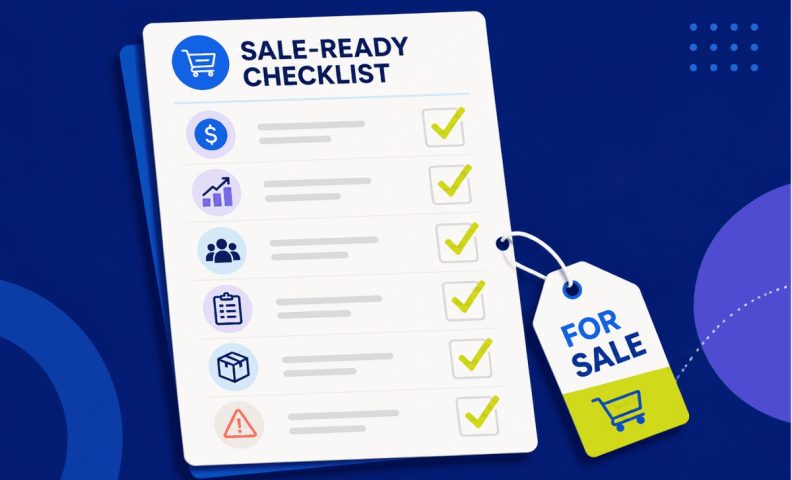
Are you planning to sell your ecommerce business that you built with not only monetary investments but also hard work, passion, innovation, and several sleepless nights? Building a business is HARD, so we want you to get the most out of it. Our advice is to not necessarily sell your business right away, but prepare your business for a better sell, if you can, in the next 12 to 18 months. Having an exit strategy and implementing it will not only make the transition easier but also add big dollar signs to your business value.
Plus, we know you probably want to ensure you get the best price for all the blood, sweat, and tears you put in your business; hence, here is a guide for you to follow before you sell your ecommerce business. If you're not quite that close to selling yet, start with our guide on preparing early for an ecommerce exit, which covers the ownership alignment and legal groundwork worth putting in place well before you get into these tactical, financial-metric-level steps.
Accurately record sales
Ecommerce business valuations are typically based on a multiple of sales. In order to ensure you maximize your business value, you must record sales accurately at its gross value. This seems simple, but a lot of ecommerce businesses get it wrong!
Instead of recording the amount of money deposited in your bank account, you need to sift through your sales channels to find actual sales numbers. Sales channels like Shopify and Amazon don't deposit all the money you receive from customers into your bank account. Instead, they deposit a net amount, after a chunk of fees and other costs that are incurred in the sales channels and payment processors.
Maximize gross profit margins
Gross profit margins for an ecommerce business is a huge indicator of success, health, and future growth. In addition to accurately recording sales, maximizing your gross profit margins in other ways is also important. Consider focusing on sales channels that have a better gross profit margin. Or analyzing gross profit margins of different products.
Cost of goods sold is another area that needs to be considered. Consider making bulk purchases to get discounts, switching to a cheaper supplier without compromising on quality, or calculating the accurate value of COGS. Minimizing your COGS will result in higher margins and a better value for your business.
Analyze and collect website traffic and user data
The ideal way of showcasing your ecommerce business performance is the website traffic statistics of past years. These metrics can easily be measured and evaluated through tools like Google Analytics, Ahrefs and Semrush. Once it's clear that the website is properly optimized with keywords and constantly ranks on Google, the traffic must be checked in regards to its diversity and quality.
An ecommerce business may generate sales from various audiences. For example, heavy marketing on Facebook would lead to a traffic surge on the website from Facebook users; however, such clicks and visits have no value to the business unless they are converted into sales. Thus, metrics like Revenue Per User (RPU), Cost of Acquisition (CAC), and Customer Lifetime Value (CLV) are used to measure the quality of leads and traffic from different marketing efforts.
Tracking metrics such as these is important to analyzing your business. If you work to improve these numbers, you will be working to sell your ecommerce business for more money. Similarly, ensure that your website traffic is diversified. Website traffic being generated mostly from one source is considered risky for an ecommerce business. It implies that any changes to a particular source would significantly impact the revenue of a company, and could result in major losses. Hence, website traffic generated from various websites and sources, each earning smaller chunks is better than fewer sources with heavy revenues.
Clean your books
I can bet your books and journals are a mess! Do not fret though, for every other normal business generally has their bookkeeping all over the place until the annual audit is finalized. However, when you're selling your ecommerce business, messy books portray a poor impression of your company to the buyer, making your company a less attractive purchase.
Hence, you need to hire the right accounting help to ensure your accounts are maintained accurately and precisely. Your sales activity, cost of goods sold, and inventory count must be clear and correct. This would not only prove your credibility to the buyer but also improve your bargaining position in front of the buyer, resulting in an increase in the value of your business.
Build your assets
Businesses are weighed at the fair value of net assets they have at the time of acquisition. Net assets refer to the difference between total assets and total liabilities of a company. Hence, you need to build your assets and minimize your liabilities.
As an ecommerce business, your biggest asset is your inventory. Ensuring you are tracking and recording your inventory correctly is important. In addition to inventory, you have a lot of other assets including customer lists, marketing materials, blogposts, spreadsheets, templates and other relevant material. Gathering these assets and making them easily presentable will help you sell your ecommerce business.
Similarly, cut down on your liabilities; pay off all possible account payables, interest payables, taxes payable, liabilities to partners, and payroll to maximize the value of your net assets.
Resolve any deal breakers
If you have any questionable activities, clear them up as it may raise red flags to the buyer. Are you running personal expenses through your business? Are you paying a family member who is your vendor through some sort of trade? (Like providing them rent.) We see a lot of interesting situations with ecommerce businesses that started out small, but sometime unexpectedly grow quickly. Make sure to clear anything up that may raise a red flag when selling your ecommerce business.
This guide to sell your ecommerce business will definitely help you get the money you deserve. Congratulations on building a successful business. We know it's A LOT of hard work. Focusing down the stretch to do the things that will increase the value of your business will pay off.
Frequently asked questions
How far in advance should I start preparing to sell my ecommerce business?
Ideally 12 to 18 months before you plan to sell. That gives you enough time to clean up your books, improve margins, and resolve anything that could scare off a buyer.
Why does how I record sales matter for my business's valuation?
Many ecommerce valuations are based on a multiple of sales, so you need to record sales at their true gross value, not just the net deposits that land in your bank account after channel and processor fees.
What website traffic metrics do buyers care about?
Beyond raw traffic volume, buyers look at metrics like Revenue Per User (RPU), Cost of Acquisition (CAC), and Customer Lifetime Value (CLV) to judge the quality of your traffic, plus how diversified your traffic sources are.
What counts as a "deal breaker" that could tank my sale?
Anything that raises red flags, like running personal expenses through the business or paying a family member or vendor through an informal arrangement. Clean these up before you go to market.
What's the single biggest thing I can do to increase my sale price?
Clean, accurate books. They prove your numbers are trustworthy, strengthen your negotiating position, and directly support a higher valuation.
Don’t leave money on the table
Getting all six of these right, accurate sales recording, tight margins, clean traffic data, spotless books, strong assets, and no red flags, comes down to one thing: having accounting you can actually trust. That's exactly where LedgerGurus comes in. We specialize in ecommerce accounting and can get your books, numbers, and financials sale-ready well before you ever sit down with a buyer.
