
An Honest Conversation on AI, Capital, and What's Actually Working in Ecommerce Finance
Merchant cash advances quote a fee, not a rate. A 10% fee repaid over four months is closer to 42% APR, and most brands never do that math. Stephen Brown and David Segal of Highbeam cover what LedgerGurus customer data shows about margins and cash, why inventory problems are operational rather than financial, how to negotiate supplier terms before borrowing, and where AI is producing real results in finance work.
Watch the recording
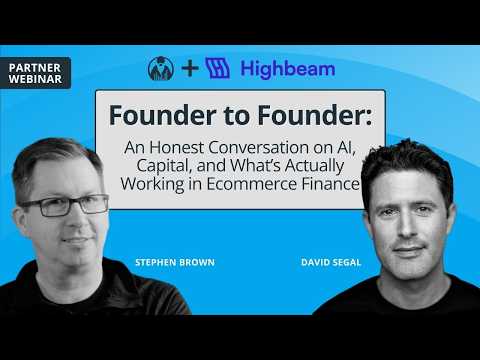
 Stephen BrownChief Operating Officer, LedgerGurusView expert profile
Show more about Stephen BrownShow less about Stephen Brown
Stephen never planned on working in accounting but saw the power of good financial information when navigating a financial crisis for a software startup he lead. When Brittany started LedgerGurus, he saw the need for all small businesses to have the power of better financial information and operations. His journey from civil engineering to software to accounting has given him exposure to many different business disciplines.
An MBA, years on the business side of software, and a decade plus of owning two businesses and working with customers has made him a formidable financial professional. His technology, business, and finance background make him uniquely qualified to help customers with their business needs.
Stephen has an MBA from the University of Utah, a Bachelor of Science in Civil Engineering from Brigham Young University and is a CISSP. Before LedgerGurus, Stephen held executive, product management, engineering, and sales roles at a variety of technology companies.
As the Chief Operating Officer at LedgerGurus, Stephen is focused on growing and scaling the business. He has also supported many businesses as a fractional CFO and leads LedgerGurus' Advisory Practice.
 David SegalPresident, Highbeam
Show more about David SegalShow less about David Segal
David Segal is the President of Highbeam and, previously, the "David" of DAVIDsTEA. He loves building businesses, and a great cup of tea. Usually in that order.
His biggest flex is DAVIDsTEA. He co-founded the company and built it into a $200M juggernaut before he sold it in 2016.
Now he is focused on building Highbeam into a world-class business banking and cash management platform. On the side, he creates and invests in projects like Firebelly, Mad Radish, and the Big Shot Show, a top business podcast. He keeps learning as much as he can along the way.
highbeam.com (opens in a new tab)LinkedIn (opens in a new tab)
Key takeaways
- Negotiate terms before you borrowOne brand's 30/60/10 payment schedule tied up a million dollars that better vendor terms could release.
- Brands can be profitable and brokeDAVIDsTEA only produced free cash flow once inventory turned about three times a year.
- A 10% fee is not a 10% rateRepaid over four months, a merchant cash advance fee works out to roughly 42% APR.
- Easy money is expensive moneyOne-click approvals price your sales velocity, and the friction of cheaper capital is worth it.
- Bad inventory data starts in operationsReceiving, returns, and influencer shipments leak, and the financials inherit every error.
- Delay the ERPBelow $10 to $20 million in revenue, total cost of ownership usually outweighs the extra capability.
Transcript
0:00 Introductions
Stephen Brown
Welcome to today's webinar. I am Stephen Brown, the COO here at LedgerGurus. I also am a co-owner of a small DTC brand. With me today, I have David Segal from Highbeam. David, do you want to introduce yourself?
0:13 David Segal
Yeah. I'm the president of Highbeam, but before that, I was actually a Highbeam customer. I built a consumer brand called DAVIDsTEA. Built it from zero to 200 million in sales. Took it public on the NASDAQ, sold it.
I was building some other brands, one of which got fed up with my bank getting 0% yield on the cash, no intelligence on the data, clunky software, bureaucratic service. Anyway, long story short, it led me to try Highbeam as a customer, was blown away, ended up becoming the president.
0:45 David Segal
And we're a cash management platform for consumer brands, anywhere between a million and 200 million of sales. We'll do about 15 billion of flows through our pipes this year. Well over 600 customers, and growing about 10% month over month.
1:06 Stephen Brown
Awesome. We're going to have a dive on a variety of topics, but really talk about ecommerce finance, some of the tools and the capital needs. It's going to be a wide ranging conversation, and talking with two people who have owned or own brands. So David, let's dive in.
1:24 David Segal
Yeah, let's do it. Well, bear with me. There you go. So you want to walk through the agenda here quick, Stephen?
1:36 Stephen Brown
Yeah. So basically, we're going to talk about three different topics. Talk about what's going on inside of ecommerce brands. Both David and I have a unique perspective working with different brands, in my case owning a small brand.
We want to talk about the true cost of capital. There is a lot of challenges around getting money, and we want to talk about the dangers of fast capital. And then we'll end up talking about AI and how it's fitting into finance and what we're seeing. Obviously we'll take some questions at the end, but we're happy to take questions as we go.
So let's go ahead and dive in, David.
2:16 What brands are up against
David Segal
So we pulled this. We took our CRM data. This was across thousands of brands. And we pulled them on what they're up against. And what came away is a cash flow story.
And it's all kind of interconnected. It was visibility in understanding their cash flow needs, where some of the gaps in cash would come, and how they were going to finance those. And it really started with the visibility both on inventory and the buys, which I know we're going to talk more about. And Stephen, I know you and LedgerGurus are one of the few fractional firms that go deep on inventory. And then understanding the inventory buys, the cash flow needs of the business, and then being able to access the right financing and the right credit, seem to be top of mind for most of these brands.
3:00 Stephen Brown
Yeah. So we want to get a pulse from those of you that are watching. I'm going to launch a poll. What are you up against most? Is it cash flow, working capital? Is it inventory and COGS tracking? Is it cash flow forecasting and visibility? Access to finance and credit, accounting complexity, fraud and security risks? You can answer more than one.
3:24 Stephen Brown
We're going to let people answer and then just see from this audience what people's issues are.
The interesting thing that I see, and one of the notes I would say, is that second point, inventory and COGS tracking. It is not directly a money issue. I would argue that it causes the cash issue. So it's directly related to the other three around cash flow.
3:50 Stephen Brown
And we see this all the time. The long cash cycles of smaller brands, the time it takes to buy inventory, usually create the cash flow issues that people are concerned about. If you're a services business like us, cash flow is typically not a big issue. But with product based businesses, it tends to be a huge challenge. And over the last couple years, we've seen such shifts in the market that it's become more challenging than ever.
4:17 Stephen Brown
I'm going to wait like 10 more seconds. We've got a handful of responses. Love to get everybody who's here responding. So if you're still putting in an answer, then we'll pull it up and see what the audience says.
4:40 Stephen Brown
David, when you were at DAVIDsTEA, how big of an issue was cash flow for you?
4:47 David Segal
Massive. I mean, brands can be profitable and broke. If you don't turn your inventory, what would happen a lot is we'd get excited about a SKU without really fully understanding how much money we had to go shopping.
5:08 David Segal
So the brands that buy at a world class level, they start with what's called an open to buy, which is really how much money can you afford to go shopping with. It takes your inventory position, what your sales were, what the receipts were, how many months of inventory on hand you have. And it becomes very directional in terms of determining what new opportunities you can buy into, what inventory is becoming stale that you need to start to promote and get out from under.
5:38 David Segal
But it wasn't until we were able to turn our inventory fairly consistently at least three times a year that we were not only a profitable business, but one that had free cash flow as well.
5:50 Stephen Brown
All right, let's see. This is really interesting. The results are almost in line with what you had, with this audience. A little bit of difference, in that people are saying cash flow working capital and cash flow forecasting and visibility, those two go hand in hand, are our top issues. Followed by inventory and COGS, followed by access to finance and credit. So the top four remain the exact same for this audience that they are for here. So let's keep going.
6:24 Cash is the constraint, not demand
David Segal
Yeah, perfect. So constraint number one, it's cash, not demand. We see this a lot where you have product market fit and you can't get the terms you need from the vendor.
Although we should pause on that. I think sometimes founders, I'll tell you a great story. I was talking to a brand, successful mid eight figure customer of ours, been in business nine years, super profitable. He was having his first kid, and I have three kids, and I said, oh, get a nanny, they save marriages. And he goes, I can't afford it, I'm constantly having to reinvest in this thing.
6:53 David Segal
I'm like, wait a minute. What are your buying terms? He says to me, I've got to put 30% down when I make the order. It takes 90 days to produce. I have to pay 60% when it leaves the port, and then another 10% when it arrives.
7:14 David Segal
So basically, by the time this person had like negative 90 day at least buying cash conversion cycles, and I'm like, if all you do in your business is get to 60 day buying terms, and you can go to your vendors and say, look, here's the history we've had, here's what we're projecting, we've been a phenomenal customer. If he's able to negotiate that, and you also line up other suppliers as leverage, it was something like a million dollars or $2 million you could take out of his business and put it into his pocket. And this is a lifestyle business and he runs for cash.
7:50 David Segal
So I think sometimes, we'll talk more about other means of getting the right working capital and how to think about debt and the difference between merchant cash advances and how they can sometimes be enormously misleading. But the number one way you can improve your cash flow is to negotiate really, really hard on your buying terms with your vendor, and paint the right story for them.
8:08 Stephen Brown
Yeah, and that's a good point, David. I mean, sometimes when you're talking about cash flow, there are many levers you can pull. People oftentimes will go straight to lending, but you really want to pull all the levers you can.
And one of those is working with your suppliers if possible. Usually what I find is you can't solve the problem without pulling as many levers as possible. And sometimes people don't always think about all those different things.
8:39 David Segal
Stephen, what do we think are the biggest levers here? I mean, obviously supplier negotiations is a big one. The right working capital line of credit. Ideally you're not financing working capital through equity, because you dilute yourself quite dramatically. What other levers do you, I mean, utilizing idle cash effectively. Are there any other big levers that you guys see?
8:58 Stephen Brown
Using credit cards wisely. They can buy you cash flow.
The other one, and this goes hand in hand with inventory tracking, is just ordering the right amount of inventory. And that is a skill that takes multiple reps to figure out.
9:24 Stephen Brown
A lot of brands got burned in the COVID era when just in time inventory [unclear] went away. But there is something about inventory optimization that can really go a long way.
9:41 David Segal
I actually think this is probably the main point of the whole thing, and you guys all identified it as your number one issue.
Jason Panzer of HexClad, on a panel with me at Holiday, put this best. Many of us have businesses that are very SKU skewed. And he goes, the hay is in the barn. You've already bought the goods, right? You have a plan of what you're going to sell.
10:04 David Segal
He's like, we often make the mistake, if you're not getting the level of profit off your advertising spend, you're faced with a difficult decision. Do I reduce my advertising spend and become more profitable? But we sometimes forget that that has a major cash flow implication. If you don't sell as much as you were planning to sell, even if it's more profitable, you can end the season with far more inventory than you had projected and a lot less cash, when a lot of bills are starting to come due.
10:39 David Segal
So at the risk of belaboring the point here, another lever is making sure that sometimes, when the inventory is there, you've got to make sure you're pushing on the right SKUs at the right time, and making sure you're turning it into cash, even sometimes at the expense of taking a little bit less to the bottom line.
11:00 Stephen Brown
And with inventory, there's a lot, especially if you're a multi-SKU business. It's really easy to allow zombie SKUs to just sit on the shelf.
And so I think inventory management, there are so many layers that go into that. Not only ordering the right amount for the right time, but also not letting the crap SKUs build up and consume all your cash. Because the way I think about inventory on a shelf is, if it's not moving, that's just cash that's locked up, taking precious resources that you could be using for faster moving SKUs.
11:36 Inventory tracking and forecasting
David Segal
Totally. Inventory and COGS tracking. We touched on this. It's your biggest asset, often a blind spot. Stephen, I know you and your firm do what most fractional firms aren't willing to do. You go deep on inventory. Maybe talk a little bit about your methods there.
11:57 Stephen Brown
Yeah, I mean, inventory is really gnarly for a lot of companies that we work with in the seven and even eight figure range, because it requires a lot of operational processes. It's not a finance exercise, it's as much an operational exercise.
So when we're working with customers, we're usually trying to help them achieve better financial visibility on their inventory. But really, to do that, we can't do that for them. We're working with them on operational visibility.
12:22 Stephen Brown
And one of the things we've seen is there are a number of places where maybe operational shortcuts or sloppiness cause issues with the data. Everything from ordering, to how you receive, to how you do your returns, to how you handle, there are other leakage points, like your marketing stuff you're sending out to influencers isn't getting tracked properly. And all that adds up to maybe bad inventory data, and bad inventory data creates bad inventory financial data.
12:58 Stephen Brown
So what we try to do is help people understand the processes they need to do, and some of the tools that they can use to do that, to build that discipline. And as you build that discipline, usually it really leads to the ability to forecast better. But until you get that operational muscle built, there are many reasons why your inventory and your financial data around inventory are wrong.
13:25 David Segal
Cool. Forecasting visibility. We're going to talk a little bit more about this later in the presentation. I mean, Highbeam today just launched Luma, our AI engine, and it's anchored on producing a really credible real time forecast that you're then able to interact with.
But what we find is, getting a clear cash flow that's real-time, live, and accurate with a solid forecast really is the basis and foundation for being able to understand where the money is going in your business.
14:02 Stephen Brown
Yeah. And cash flow is really a tricky thing to forecast, because there are multiple things that go into it.
When I work with new customers, a lot of times I'm like, tell me about your revenue plan. And there's a discipline you have to build up there. That oftentimes is driven off of a marketing plan, and then that data drives your inventory planning, which all feed into a cash flow plan.
14:27 Stephen Brown
And so a lot of times what's hard as a finance person, when I'm working with people, is you're trying to forecast cash, but a lot of these other things haven't been built. And so there's a lot of muscle that needs to go into it.
So I'm really excited about some of the things like Highbeam's doing, because these aren't easy things to do, and I think the more you can do to automate and streamline this, the more it'll help people make better projections.
14:53 David Segal
It reminds me of the Mike Tyson saying, everybody has a plan till they get punched in the face. When you put together a cash flow, you put it together once, it's often in Excel with a lot of formulas, and then the show starts, and whatever your marketing and your inventory plan was, ultimately, this expression, buying, you always buy too much or too little. So you're always making these constant adjustments in your business, both in marketing, both in inventory.
15:19 David Segal
And what we try to solve for at Highbeam, and have successfully done, is all of those micro ongoing changes that are happening day by day, and being able to adjust the model in real time in a conversational way, and in a way that it's able to roll forward itself and stay live and current. So anyway, we'll talk more about that down the line here.
15:49 Stephen Brown
I have an even better quote. I don't know if I've told you this one, David, but there's a statistician, George Box, that said, all models are wrong, but some are useful. And I love that quote, because you plan and nothing goes according to plan, but if you have good, flexible plans, they can guide you as things shift and change.
16:10 David Segal
Exactly. This, Stephen, came from your data, so I'll let you explain it.
16:17 Stephen Brown
Yeah. So we did a study a few months ago across some of our customers, because there are a lot of analyses out there, but we don't have a lot of confidence in them. Because unless you're overseeing the books, we know that there's a lot of potential problems in the data. And so we did an analysis of some of our customers to see what we were seeing.
16:42 Stephen Brown
And a couple things that pulled out. The leaner COGS definitely had a better outcome. That should be no surprise.
We saw gross margins being compressed, and that shouldn't be a surprise either, with the tariffs, with all of the things going on. Side note, if you aren't chasing your tariff refunds, you really should be. Those are out there. But tariffs are creating margin compression, inflation's creating margin compression.
17:11 Stephen Brown
The other thing that we saw with top performers is the amount of cash that they had, and that shouldn't be a surprise. The more profitable businesses have more cash. Cash creates opportunity. It creates many things.
17:30 Stephen Brown
One of the interesting things in our data that we saw was a lot of wholesale, and we weren't sure if wholesale was a key to success or if it was just a key to the customers that we work with. Our thesis is that we've attracted a lot of those. I can tell you many brands who have wholesale that have terrible outcomes, if you don't execute it right.
But a lot of the basic principles apply. Good gross margins lead to better profitability. Good profitability creates more cash, and it becomes a virtuous circle. So a lot of the things we saw there weren't a surprise, but it reinforced some of the best practices we already know.
18:16 The true cost of capital
David Segal
Cool. Now we're going to talk about the true cost of capital. You guys listed funding your working capital as one of the key considerations. And this is a topic I know that gets Stephen fired up as well as me.
But often these merchant cash advances are completely misunderstood. And the biggest, it really stems from this idea that the fee that they quote you is an annual percentage rate, APR. Stephen, I know for you this is a real thorn in your side.
18:55 Stephen Brown
Yeah. I've seen customers who have gotten in really bad shape over getting bad loans. And I think part of the challenge they run into is when you're small, you can't get a really good business line of credit with a bank.
And by small, that can be, I've seen brands that are eight figures, $10 million plus a year, and banks won't give them lending. And it takes time to build up those relationships. And so they find themselves chasing what looks like easy funding.
19:31 Stephen Brown
And I feel like what you see from these merchant cash advance lenders, I like to use the equivalent of, they're like the payday lenders of this industry. They are predatory in nature. They don't communicate the real costs, and they position it as a fee.
And I think as consumers we're used to annual percentage rates, and so we see 10% and we're like, well, I guess that's not so bad, right? But when you actually do the finance math, it turns into something much bigger.
20:03 David Segal
Yeah. And we actually did the math for you. We're going to show you a calculator in a sec.
But the reason why the fee ends up being so much higher when you break it into an annual percentage rate is that the fee is constant. And so you're paying back the principal every single time they draw from your sales. And your principal is going down, but your fee stays exactly the same. And you're paying it back within shorter time frames than a full year.
20:39 David Segal
So a 10% fee on a four month payback is actually a 42% APR, which is predatory, frankly. It's a huge amount to have to pay.
20:52 David Segal
And so, rather than go from this presentation to our calculator, Highbeam actually, first of all, Highbeam has a true line of credit. There are no fixed fees. There are no origination fees. It's true APR. You only pay for what you use. We look for businesses that are either profitable or on the brink of being profitable and growing fast.
21:16 David Segal
You can use it for 5 days, principal will go down over those days, and we calculate the interest on the principal that's outstanding by the day. You can pay it off at any time without penalty or additional fees. So it's transparent, and it tends to be significantly less expensive than merchant cash advances.
21:35 David Segal
And if you're on a merchant cash advance today, or you're curious to see the difference, we can even send this out in a follow-up email, but highbeam.com/apr, there's a calculator right there. If you run through it, it'll basically compare what you're borrowing versus what it is. You plug in what your flat fee is from your merchant cash advance, and we can compare it to what you would pay with Highbeam. And it's going to end up being dramatically cheaper, as you can see here from these rates. And it ends up being real dollar savings.
22:11 Stephen Brown
And this is a really great tool that I highly suggest. A lot of people have a hard time wrapping their heads around how these fixed fees turn into an APR.
What happens is the merchant cash advances will look at your sales velocity and say, hey, it's going to take about 6 months or so to pay back this loan. And they give you a fee around that payback period.
22:36 Stephen Brown
Now, obviously, if you could stretch that payback, that APR wouldn't be so egregious, but usually that's not a good thing, because that means you're slowing down sales. And often that could be taking sales down to a point where you're actually decreasing your growth.
And so they are projecting a level of growth that you want, and there's a payback period. And usually I'd validate and say, hey, how long do I think I'm going to pay back this loan? The faster you're going to achieve that payback, the worse the cost outcome is.
23:19 Stephen Brown
And so there are alternatives, and Highbeam is one of those, being focused specifically on ecommerce and consumer businesses.
The other thing I like to think about is the easy money is not always good money, right? And the merchant cash advance is literally like, here's your offer, click a button, go. And they're just saying, hey, we see the sales velocity that you have in your Shopify store, your Amazon store, running it through PayPal, whatever it is. And they are building their confidence around your ability to pay back just based on what they've seen on a sales history.
23:54 Stephen Brown
And so it makes it really easy. And a lot of people don't like to jump through a lot of hoops of getting lower cost capital, but I can tell you it's well worth it. I do have some crazy horror stories around merchant cash advances.
24:08 David Segal
Yeah. And just to the point, I think you brought up something really great there, Stephen, in terms of the friction, and the easy money is often the most expensive money.
Highbeam, we'll get you an answer in 48 hours. You literally plug in your QuickBooks and we can tell you. And if you want to compare the cost, just go to highbeam.com/apr, and this is what you'll see. It's an apples to apples comparison. You can look at merchant cash advances, asset backed lines, term loans. You can see the difference. But you would just plug in what is your fee, what's the payback period, the payment frequency, and it'll compare the two for you and tell you your savings. And also show you what happens if you pay back sooner as well. To your point, the sooner you pay back the merchant cash advance, the more expensive it actually tends to be.
24:52 Stephen Brown
One of the things I would suggest in using that calculator is to look down at the bottom too. There are a lot of really interesting considerations you have to think about with lending around penalties and early payback fees. Those are things that people don't always think about, because they're not comfortable with them. But some of those finer point smaller details can come back to bite you as well.
25:15 AI in ecommerce finance
David Segal
All right. AI is all the hype. We'd love to talk to you about what we've done for ecommerce finance, and what's signal and what's noise.
And what you as a brand, I mean, you all know you need to be using AI in your businesses. Just taking a sneak peek at the list of attendees, I see a few who I know for a fact are AI power users today. We'll talk to you a little bit about what Highbeam's done, why it's different, and where we think you can get the most leverage.
25:56 David Segal
So Stephen, what are you seeing? I mean, customers must come to you all the time and be like, how are we using AI to be more effective?
26:03 Stephen Brown
Everybody, I think people are all over the spectrum. You've got everything from people still figuring things out to trying to go all in. And I think a lot of people doing ecommerce are very tech friendly.
And AI is changing so quickly, and I think one of the challenges is understanding what's real and good recommendations versus what is not.
26:32 Stephen Brown
We've been doing an experiment over the last couple of months internally, using a variety of tools and just running financial statements and saying, analyze these. And we're seeing a lot of improvements.
But there's also a judgment call to the recommendations. When I look at recommendations that AI is giving me, I also have to apply my experience filter on top of that to make sure I understand what it's telling me. And there's always that hallucination concern. But what I am seeing is continued and really interesting improvements that are accelerating what we can do around normal business processes.
27:23 David Segal
Yeah. We'll talk a little bit about what we built with Luma, which is the AI engine that powers Highbeam, that we actually just launched today officially. But we spent over a year now developing it, going through multiple iterations.
What we found is a few things. One, when you take all your data and you plunk it into the latest and greatest model in Claude, three things happen. The first is they're not very good at being deterministic and having the context. So you can play with it and work with it, but if you want to do a repetitive workflow, what you do on a Monday often is not replicated well on a Friday with the same types of prompts.
27:59 David Segal
Two, you end up spending a fortune on tokens, because it pulls everything into the context window. And you put it in the best model possible. I make the analogy, it's like taking a Ferrari to the grocery store, right? You have the best model of Claude to do the most basic of tasks. It isn't necessarily the most cost effective way to do it.
28:22 David Segal
And then three, it struggles to give you a record of what it actually did. Which is why, I will explain, we took a bit of a different approach with how we built Luma with Highbeam.
28:39 David Segal
But what we often tell our customers is, look, pick one painful workflow. We'll work with you to prove it out and then expand from there. We started with forecasting as sort of the most common one we see, across cash flow reporting and forecasting. Automate that workflow, keep humans in the loop as well, especially experts like LedgerGurus on the finance side.
28:56 David Segal
And look at tools that, first of all, it should be in a secure environment where your data is protected, which is something that was super important for us at Highbeam. And ideally what the AI does is auditable, especially when you're dealing with financial information.
29:15 David Segal
So Luma dropped today. It takes into account your QuickBooks or NetSuite, your banking, works great obviously with our banking at Highbeam. Your cards. You can get inventory information in there. And you're able to interact with it both in the Highbeam app and in Slack.
29:36 David Segal
We built it so that Luma actually writes code when it does its query. So when you ask Luma to do something, it writes code for a process to then go and do it and repeat it. And it has the context of 15 billion in consumer brand flows that Highbeam has through its pipes, while still making sure every single instance of Luma for our customers is unique and secure.
30:01 David Segal
We started with automated cash flow reporting and forecasting. You can update that forecast in Slack, and it tracks all the updates that were made, by whom and when.
When you look at it, you're able to go in and see how it did its forecasting. It looks at a confidence interval. Did it do back testing? Did it have enough data? And it'll tell you how it built its forecast, and how confident it is in the forecast and why.
30:32 David Segal
And then within Slack, you're able to interact with it in order to answer everything from building open to buy reporting, sell through to understand what SKUs you need to push that week, capital needs to support your growth and comparing different capital offers, debt to equity considerations, moving money more efficiently, who to pay when and where to borrow, what to do with your idle cash, live P&L, the plan projected. So there's a series of different reconciliations as well.
31:02 David Segal
And I know we've worked a lot together, Stephen, to take some of the secret sauce you guys have at LedgerGurus and build your specific Luma instance for what you guys are doing with all of your expertise.
31:13 Stephen Brown
Yeah, I mean, there are some interesting theories out there. One is the general AI tools are just going to do everything we need. The other theory is focused tools are going to leverage AI to become more effective.
I personally am a fan of the second. I think what Highbeam's doing here, leveraging the general AI but in applied fashion, is the way. I think when you're using a general AI tool, it may or may not give you what you want.
31:51 Stephen Brown
David, tell me how have you guys trained Luma to do the things that you're talking about?
31:57 David Segal
Well, first of all, we have an existing customer base, right?
I won't go too technical, mostly because I'm not an engineer. But the way I describe it is this. It's like you can make your own ice cream. You can buy all the ingredients. You can buy a book on how to make ice cream. You can get the machinery to make it. You'll spend a lot of time producing ice cream.
32:29 David Segal
Some of you will make phenomenal ice cream and become incredible power users, to the point where you're basically engineers that could work for a tech company to do this. Most of you though won't. And you'll come up for air and realize your ice cream costs significantly more money, doesn't taste as good, and took way too much of your time, than the artisanal ice cream shop that's at the street corner selling for $3 a cone. And Highbeam is that ice cream shop.
32:54 David Segal
I mean, we have a team of, I don't know, 25 engineers, MIT caliber engineers, who spend their every waking moment perfecting Luma, training it on all the use cases we see across our customer base, cross-pollinating the learnings we get from any one of those customers, of course keeping all data enormously secure on an individual instance basis. And then also keeping abreast of all the latest and greatest models, and knowing which model to use for what type of query, in order to make it a lot cheaper than plugging all your stuff into Claude.
33:31 David Segal
And the end result, just as a founder myself, I've had the chance to play around with Luma over the past couple weekends. The quality, I mean, I've been using Claude, of course, like you all have. The quality of the responses is better, to the point where I've had some real holy [expletive] moments where I've asked it to do some fairly complex queries around margin breakdown, around understanding my inventory, my growth relative to my cash troughs and where I'm going to need money and for how long. It's able to synthesize a lot of information and provide clarity.
34:06 David Segal
And we call it sort of either success by a thousand cuts or death by a thousand cuts at Highbeam. The reality is most founders, you're busy. You didn't go into business to optimize little money flow decisions. You went into business because you have a product you think the world needs, and you want to get it out there and tell the world about it and sell it and create a lot of happy customers.
34:29 David Segal
And what we're able to do through Luma now is put a lot of small financial decisions on autopilot. And what we find is, when founders don't have the information and the clarity, and the reality is it's hard, there are just a lot of moving parts, they make a lot of small finance decisions that aren't optimized. Each one of those is not a big number in terms of your bottom line, but over the course of the year it ends up being tens if not hundreds of thousands of dollars.
34:58 David Segal
And so Luma is really the tool that is now going to be pervasive across our platform, that allows brands not only to understand their businesses better and interact with their financial data in real time. It's also going to be the tool that allows LedgerGurus to get more leverage to understand your business. I think, Stephen, you put it best when we met, where it's like this is now just a more sophisticated machinery for us as experts to interact with. But it's also going to help you streamline your money movements in order to borrow smarter, get the most out of your idle working capital, and pay bills in a way that optimizes your free cash flow and not someone else's.
35:31 Stephen Brown
Awesome. Well, I'm excited to see how this progresses now that you guys have launched it.
We talked very briefly about some of the things you do. Obviously here at LedgerGurus we're focused on finance and accounting services, and we are focused on ecommerce and consumer brands. David, what are some of the things we didn't talk about that Highbeam does?
35:56 David Segal
I think we covered everything. I mean, banking is now a feature as part of a cash management financial platform. I think that's one of the biggest takeaways that we've had.
You think about what a bank historically does for you. It's a cost center. It's a necessity. Somewhat of an afterthought. You call them sometimes between 10 and four and press one for English and two for Spanish on a 1-800 number. Occasionally they lend to you, but to your point, Stephen, it's usually once you have enough money where they can lend you your own money back to you. They maybe give you a card.
36:33 David Segal
That's evolving, where banking is now becoming a profit center, a financial platform, cash management tool that really helps you optimize your cash flow, borrow smarter, and be able to make better decisions in business.
36:50 David Segal
And really, we don't see a world where financial expertise isn't needed. And that's where LedgerGurus comes in. In the accounts we've had, it's a 1 plus 1 equals 3 scenario, where LedgerGurus really brings that expertise and is able to be your thought partner as you grow your business and make really important decisions with your money, and with your inventory, and with your marketing, and all of your strategic opportunities. And just be able to do it with clearer data and a more streamlined way to move money.
37:27 David Segal
And that's where we see the future. Whereas I had 10 people in finance at my peak at DAVIDsTEA, we were doing about 200 million in sales, they were doing all this manual spreadsheet work. I think the future is being able to scale your business without having to scale your finance team, and being able to use great fractional firms like LedgerGurus. So I think it's fundamentally deflationary for all the brand founders on this call, and a really exciting time where businesses can run a lot more profitably.
37:51 Questions
Stephen Brown
So I've got a question. Which legacy SaaS do you all see that are integrating AI in ways that allow small business to integrate AI workflows and automation of repetitive tasks, without the expense, time, risk of developing bespoke AI solutions with LLMs, training and discipline? Any new SaaS players besides Highbeam that are doing smart scalable work in this space?
38:24 Stephen Brown
Let me give a general answer. So before I came over to work with my wife who started LedgerGurus, I spent 20 years in enterprise software.
Everybody is doing something in AI. If your SaaS vendor doesn't have an AI roadmap, that should be a concern. You've got a lot of new solutions that say AI first, AI native, that are coming out there. But the devil's in the details, is what I've learned over the years of building software.
39:01 Stephen Brown
And the thing about software is not just the features, it's the supportability, it's the velocity. So I've always been afraid of building organic software. Not afraid, we've done a little bit here at LedgerGurus. But you have to realize, how many people can support that application? There's still an expertise to doing that. And if Joe, who built that really great application, leaves, are you going to be able to take it over for him?
39:33 Stephen Brown
So the first thing I think about when building my own apps is supportability and longevity around them. And there's still an expertise to building an app.
Now, there are a lot of apps, like a lot of Shopify plugins, that are just really basic, that probably will get consumed by homegrown apps, or they're going to get rolled into bigger suites.
40:00 Stephen Brown
The second thing I think about is existing vendors that are really big, and how aggressively are they applying AI features into their existing tech stack. And again, I think everybody's doing stuff, but what we're trying to see now is who is creating real value and who is just putting AI into their roadmap.
So I think we're in a time of transition that we haven't really seen a settling, but I think what you're going to see is those that are leveraging AI effectively roll out capabilities faster and faster than ever.
40:40 Stephen Brown
What's your take, David?
40:42 David Segal
I think you're right. You can spin something up really quickly. We learned this, and we did this quite frankly at the start when we started playing with AI. You can spin stuff up really quickly and give it a nice look and feel and have a lot of sizzle around it. But it fundamentally won't catch, because it doesn't work well.
41:10 David Segal
It's like an iceberg. I run sales and marketing at Highbeam, and I'm a founder, so I want everything yesterday. So I go to my product and engineering team, I'm like, where is it? We're behind. When are we getting this?
41:22 David Segal
But the reality is, if you don't take the time to build the infrastructure right, to build the harness, which is the contextual layer that allows us to get far higher quality answers for less money on the tokens, with something as specific as consumer brand finance, and be able to create repetitive workflows that run smoothly, if you don't get the underlying infrastructure right, it's hard to build on top of it. So 90% of the value gets created in the last 20% of the race.
41:57 David Segal
So I think you're right that the brands that are doing this well are rolling out new functionality quickly. But that's very hard to do unless your infrastructure layer, the way you've built your system, is truly rock solid.
42:08 David Segal
So the good news for all of you on this call is everybody's got a free trial, right? It's very low lift and low risk for you to try this stuff out. For us, for example, and I'm sure every vendor is going to be like this, you can connect in your data. It takes 10 minutes. You don't even need to bank with us at the start. Obviously we want to win your business, and we're going to show you the value. But you can connect in, you can try out Luma for 14 days. You can come back to me and tell me it sucks, or you can come back to me and say, wow, I can't imagine running my business without it.
42:45 David Segal
And we're now at the point where we're putting it out to the market for the market to be able to do that, because we've tested this enough to know that there's a higher probability of the latter rather than the former.
So I think it's a really exciting time to be running a consumer brand, where you can dabble a bit and learn. If you're a curious person who's a tinkerer, I think you're going to go way further on this stuff.
43:17 David Segal
I'm sure all of you have already played around in Claude, and some of you to different degrees of success. I think now we're entering an age where you should be playing around with some of the tools that have come on the market to see who your artisanal ice cream shop is going to be. And I don't think you need to listen to anybody's sales spiel and believe them at face value. I think you just need to try.
43:42 Stephen Brown
Awesome. I've got another question from Arthur, and I think this is probably more directed to me. Do you run inventory tracking through QBO, QuickBooks Online, for any clients?
Short answer is no. The inventory management capabilities of QuickBooks Online have not been adequate for ecommerce businesses.
44:00 Stephen Brown
You said, at what point do you transition to inventory management systems from QBO? Could you run it through QBO?
So let me talk about the challenges of inventory management for ecommerce businesses. There are obviously some core inventory management capabilities, and inventory management can be extraordinarily complex. Ideally, you also need it to be able to talk to all of your sales channels. The best inventory management systems are a system of record that are providing available inventory to your different sales channels. So they'll have integrations with those sales channels.
44:43 Stephen Brown
QuickBooks Online inventory management hasn't really built what we feel like our customers need. We have talked to Intuit a lot and they are continuing to invest there.
But inventory management for ecommerce is a really challenging thing. There are no clear winners at this point. There are a few that we have worked with, but there are so many options out there.
45:08 Stephen Brown
And the things that I would look at with inventory management systems are their depth of capabilities. How do they handle the different use cases? How are their integrations? What is their reputation? And then I think with every software these days, I want to understand what they're doing with AI and what their AI roadmap is, and then how quickly they're executing on that. Because increasingly that's going to be make or break for software vendors, is how well they're leveraging AI capabilities within their software.
45:40 David Segal
Stephen, we often see people move to NetSuite and then back to QBO. They go through these complicated integrations with NetSuite only to find out it's got more horsepower than they actually need. How do you think about NetSuite, and when is the right time to transition out of QuickBooks, and how would you approach that?
46:05 Stephen Brown
NetSuite is very robust. They have become like the ERP of choice for a lot of vendors. They got acquired by Oracle many years ago. Oracle is a very aggressive company, probably the most aggressive enterprise software company of scale that I know of. They have a tendency to sell down market.
46:24 Stephen Brown
A lot of times they will say, hey, we're going to solve your inventory management problems by putting it all in one platform. When you go to an ERP, you've got to realize you're moving everything there. You're moving your financial software. You're moving your inventory management. If you're doing warehouse, you're doing your warehouse management.
46:47 Stephen Brown
And they are very expensive to implement, very expensive to operate. Usually you need an expert to support that. And a lot of times it's overkill.
I don't know that there's a revenue number that I would be like, this is the time when you go to an ERP. I would just say you really need to look at the total cost of ownership, which is the cost of implementing, which is tens sometimes hundreds of thousands of dollars, the cost of running the software, the cost of the people supporting the software.
47:20 Stephen Brown
And then the other thing we see with NetSuite and other ERPs is they are designed to be very, very complex, and their usability is lower. And so what took like three clicks often can take 10 or 20 clicks in an ERP, because they're just giving you more capabilities.
47:31 Stephen Brown
And so our opinion is, if you can put off moving to an ERP as long as possible, it gives you the ability to go fast. Now the downside is you've got to work with federated systems. You'll need an inventory management system, maybe you need a warehouse management system, and you've got to deal with the challenges of integrating different systems and keeping them in sync. But usually those systems are easier, have better usability, and allow you to not put as much energy into managing this monster ERP, and actually be able to focus on growing your business.
48:19 Stephen Brown
So that's kind of our general opinion, and we've seen a lot of people that have had ERPs that have failed.
I would say as a rule of thumb, unless you have a very unique business, I wouldn't even think about ERPs till 10 million and oftentimes 20 million in revenue. There's going to be a point where it makes sense, but don't let the Oracle salesperson convince you to go get an ERP at $2 million in revenue.
48:50 David Segal
Cool. And what about you? When did you guys move to ERP at DAVIDsTEA?
48:53 David Segal
Oh my god, that was a nightmare. We had Microsoft Dynamics. Then we had an inventory system called Just Enough that the team of 10 planners, or five planners, five allocators or whatever, we had stores, used to call Never Enough.
49:14 David Segal
I mean, the lesson I always take away is, no one loves their ERP or their accounting system. No one, I've never had anyone say, or their POS, their point of sale system, or any of these. No one's like, you know, I love QuickBooks, or I love NetSuite, right? There are none that are, to your point, the clear leader that have truly solved it. And I think the reason for that is it's really hard to solve.
49:37 David Segal
So my experience has taught me the same, where it takes twice as long and costs twice as much as you think it's going to to implement it, and the longer you can put it off the better.
And I actually think some of the AI functionality is going to converge a lot of these different systems, where extracting the information you need, for example with us, if you can get an accurate inventory picture, even if it's not through a formal ERP, into Highbeam, into Luma, and we've already done this, we're able to do some incredible things with it. So whether it's us or otherwise, I think I agree with you, the longer you can wait the better.
50:24 Stephen Brown
Yeah. Awesome. Any other questions out there? We had some good ones come up.
50:34 Stephen Brown
Okay. Here's another question. What are thoughts on Webgility for perpetual inventory? It's kind of a mess, but the only option I've looked into on the market.
We have worked with Webgility. We weren't able to get it to work. Unfortunately, Arthur, we spent a lot of time working with them. It's been a while. I'm not sure if they've changed, but our experience was we weren't able to get it to accomplish what we were trying to accomplish. So that's our take, but I would also say it's been a little while since we've looked at Webgility. So don't completely discount it. We just weren't able to get it to do what we thought it was going to do.
51:20 Stephen Brown
Any other questions?
51:26 Stephen Brown
All right. So David, if somebody wanted to reach out to you, talk about Highbeam, what's the best way to do it?
51:33 David Segal
You know what? Send me an email. You've got, last slide, I think you've got your information there.
51:39 Stephen Brown
Yeah. Oh, do I?
51:41 David Segal
Yeah. It's david@highbeam.co.
51:52 David Segal
Of course, today we've presented you with, Highbeam is about great tech and being able to give you cutting edge capabilities that truly give you leverage and save you money. But we also give you old fashioned banking service the way it was a hundred years ago, where you get our cell phone numbers.
52:12 David Segal
I mean, what we tell our customers is, we're going to treat you the way JP Morgan treats Microsoft. So it's not like I do the webinar and disappear. Email me direct. I'll obviously connect you with the right person on the team, but you'll have my cell number and you'll have access to the entire Highbeam team as well.
52:30 Stephen Brown
You guys are doing banking and finance solutions focused purely on consumer brands. We do accounting and finance services only on consumer brands. There's something to say about that focus that gives us the ability to help our customers.
52:44 Stephen Brown
Awesome. Feel free to reach out to us.
Oh, one more question. Can we try them for free?
52:52 David Segal
Dorothy, yes, there'll be a trial period. There's a waitlist right now. We literally just dropped it today and have seen incredible demand. If you go to highbeam.com, there should be a link to Luma. Or if you just check my LinkedIn or any social right now, we're abuzz today.
53:08 David Segal
And yes, there absolutely will be a trial period where you connect in your data and you can use it. And I highly encourage you to do it. We could talk about it all day long, but there's nothing like seeing it and having a wow moment.
53:26 Stephen Brown
Awesome. Okay, thanks everyone for joining. Thank you, David. We hope to connect with many of you in the future. Take care.