

Even at an early stage, it's worth finding a bookkeeper or accountant who actually understands ecommerce. Many of our clients' books are a mess when they first come to us, usually because a previous bookkeeper didn't understand ecommerce accounting, and that can lead to real, poor business decisions early on.
Full ecommerce-specialized services can cost more than a small business needs right away, since they involve a more detailed level of financial reporting than basic bookkeeping. You may not need that level of detail yet. But as your business grows, that detail becomes a genuine game-changer, so it's worth finding someone who understands these principles from the start, rather than switching later after a mess has already built up.
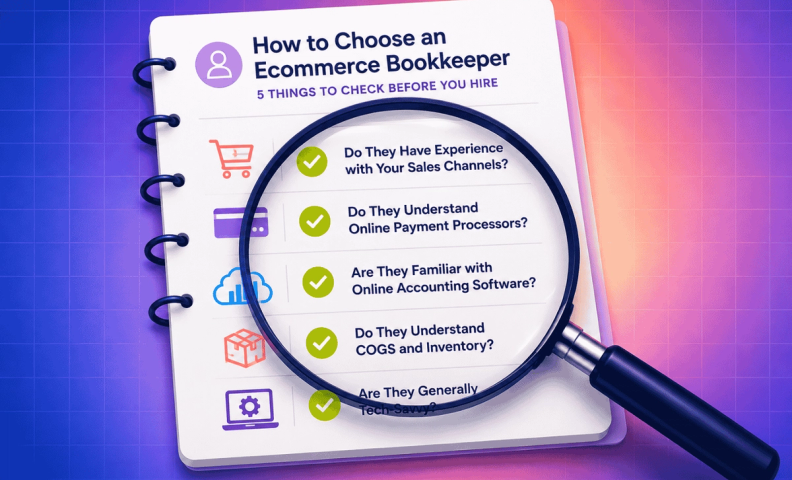
Here are five factors worth checking when you're evaluating an ecommerce bookkeeper.
Do they have experience with your sales channels?
One of the biggest differences in ecommerce accounting is that financial activity flows through your sales channels, not your bank account. For most other businesses, bank statements give you the data you need. For ecommerce, a deposit from Amazon or Shopify doesn't tell the full story, recording that deposit as revenue as-is typically understates your actual revenue and hides other important information that can come back to bite you later.
A good ecommerce bookkeeper knows they need to dig through your sales channels for accurate financial data. They may be familiar with tools like A2X, which connects data from Amazon Seller Central or Shopify to accounting software like QuickBooks Online or Xero.
Since they'll be working through your sales channels directly, look for someone with experience doing exactly that, ideally with your specific platforms.
Do they understand online payment processors?
Depending on how you collect customer payments, online payment processors add another layer of nuance. They charge fees that need to be tracked accurately, and your bookkeeper should periodically reconcile your payment processor data against sales channel reports and bank statements. This confirms you're actually receiving everything you're owed.
For more information, read How to Reconcile Your Ecommerce Deposits (and Catch What's Missing).
Are they familiar with online accounting software?
Ecommerce businesses should be using online accounting software like QuickBooks Online or Xero, both of which support a wide ecosystem of integrated apps for sales tax, payroll, inventory, and more. That said, be cautious about which apps you actually connect. Learn why integrating apps can sometimes backfire.
Since this software is central to running an ecommerce business well, make sure your bookkeeper is genuinely comfortable with it.
Do they understand COGS and inventory?
The most important number an ecommerce bookkeeper needs to get right is your gross profit margin (GPM):
Gross Profit (Revenue − COGS) / Revenue
Most of your business decisions hinge on gross profit, it determines what you have left to spend on marketing, hiring, consultants, and more. For more on budgeting around GPM, read Why You Need an Ecommerce Budget.
Getting GPM right means accurately recording revenue and COGS, which requires understanding how to calculate COGS per SKU and when to record it on your books, both covered in Cost of Goods Sold (COGS): Key for Ecommerce Business Success .
COGS and inventory go hand in hand. Your balance sheet's inventory number should reflect what you actually have on hand, and when a product sells, COGS should be expensed while inventory value decreases accordingly. Make sure your bookkeeper genuinely understands both principles.
Are they generally tech-savvy?
Ecommerce businesses run on a lot of technology, and your bookkeeper will be working with plenty of it. Look for someone with a general comfort level across the tools common in ecommerce, not just accounting software specifically.
Frequently asked questions
Why do I need a bookkeeper who specifically understands ecommerce?
Because financial activity in an ecommerce business flows through sales channels and payment processors, not just your bank account. A generalist bookkeeper who only tracks bank deposits will misstate your revenue and miss critical information.
What should I ask about a bookkeeper's experience with sales channels?
Ask whether they've worked with your specific platforms (Amazon, Shopify, etc.) before, and whether they're familiar with tools like A2X that connect sales channel data to your accounting software. Direct experience with your exact channels is a real bonus.
Why does payment processor knowledge matter for ecommerce bookkeeping?
Payment processors charge fees that need to be tracked accurately, and your bookkeeper should periodically reconcile processor data against your sales channel reports and bank statements to confirm you're receiving everything you're owed.
What's the most important number an ecommerce bookkeeper needs to get right?
Gross profit margin = (Revenue − COGS) / Revenue. Nearly every major business decision, marketing spend, hiring, growth, depends on this number being accurate, which means your bookkeeper needs to understand COGS and inventory accounting deeply.
When should I consider more advanced ecommerce accounting than a bookkeeper provides?
Generally, as you approach $1 million in annual revenue. At that point, things like sales tax compliance, product velocity, in-depth inventory accounting, and system integrations start to matter more, and that's where a specialized ecommerce accounting service comes in.
When you're ready for more than a bookkeeper
Finding an ecommerce bookkeeper who understands these five things will save you real headaches as your business grows, and gives you a solid foundation for more advanced accounting down the road. For the bigger picture on what makes ecommerce accounting different in general, see our Essential Guide to Ecommerce Accounting.
As you approach $1 million in annual revenue, that's usually the point where a specialized ecommerce accounting team, not just a bookkeeper, becomes the right fit. We can help with sales tax compliance, product velocity and profitability, in-depth inventory and COGS accounting, system integrations, and more.
