

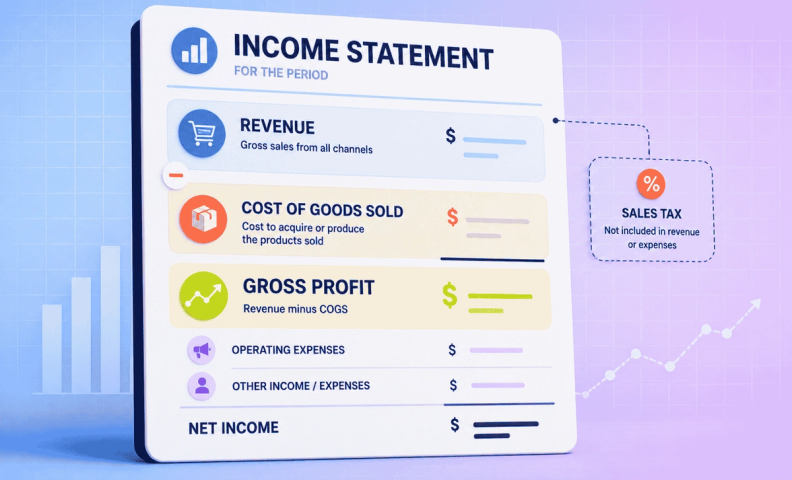
Your income statement is one of the three core financial statements, alongside your balance sheet and cash flow statement. Getting it right comes down to knowing what should, and shouldn't, show up on it: sales tax shouldn't appear at all, revenue needs to reflect your actual sales activity rather than a net deposit, and COGS should move in a stable, predictable relationship with sales. Let's go through each one.
You can also view our YouTube video “How to Read and Analyze Your Ecommerce Income Statement” that goes more in-depth on what an income statement is, what questions it can answer, and how to use it in the everyday decision-making for your business. We highly encourage you to view that video as it covers very different information from this article.
What makes an ecommerce income statement different
The income statement accounts of a company, or the “Profit and Loss Statement” accounts, start over every period unlike balance sheet accounts. When the period ends, you need to close it out and empty the accounts into different balance sheet accounts.
The ecommerce income statement is very important as it shows the ability of a business to make a profit. It's crucial to get it right so that it correctly communicates the state of your company's financial health. And your financial health becomes super important when it comes to getting investors, loans, or buyers for your business.
The most common mistakes we see with ecommerce income statements are in the following areas:
- Sales tax income/expenses
- Revenue
- Cost of Goods Sold (COGS)
Getting sales tax off your income statement entirely
The most important thing to check when it comes to sales tax income and expense is if it is on the income statement at all. Why? Because you do NOT want it showing up on your income statement. I repeat. Nada of the sales taxes (whether income or expenses) should show up on your income statement. Collecting sales tax does not qualify as income and remitting it to the government doesn't qualify as an expense. All that information belongs on your balance sheet.
If there are sales tax income or expense accounts showing up on your income statement, then you should do some further digging as this indicates an issue with how your accounting staff is handling sales tax. This is not a common issue that we see, but it is still one to be aware of as it will result in a misstatement on taxable income and impact your tax return numbers.
Read here to learn about how sales tax should be handled on your books.
Getting revenue recorded correctly
Ecommerce companies vary more than any other type of business when it comes to recording revenue, which is exactly why it's worth having an accountant who understands ecommerce accounting specifically.
Most businesses have it easy here: their transactions pass straight through bank accounts and credit cards, so recording that activity is recording revenue. Ecommerce doesn't work that way. Most transactions pass through sales channels first, and only the net settlement deposit ever hits your bank account. If an accountant records that deposit as revenue, they're misstating both the amount and the timing of your actual sales.
Here's what that difference looks like on the income statement.
Wrong (deposit recorded as revenue):
| Line Item | Amount |
|---|---|
| Revenue | $44,170 |
One line, no detail. This tells you almost nothing, and it's not even your real sales number. It's what's left after Amazon (or whatever channel you sell on) already deducted fees, shipping, advertising, and other costs.
Right (channel activity recorded correctly):
| Line Item | Amount |
|---|---|
| Gross sales | $125,958 |
| Shipping | - $21,209 |
| Amazon fees | - $18,681 |
| FBA fees | - $13,128 |
| Advertising | - $418 |
| Timing adjustments | - $25,360 |
| Gift card credits | - $2,992 |
| Net Revenue (Deposit) | $44,170 |
Both versions end at the same $44,170 deposit, but only the second one tells you anything. It shows you exactly how much you actually sold, what it cost you to sell it, and where every dollar went, the kind of visibility you need to price products, evaluate ad spend, or catch a problem before it grows.
To check whether your own revenue is being recorded this way, ask two questions:
- Does your sales data match your monthly channel data?
- Do your income entries show only revenue, or do they also show the underlying activity, merchant fees, channel fees, shipping?
To answer them, dig into your channels' back-end reports for the gross data, tie that to the payment processor each transaction ran through, then tie that to the deposit that actually hit your bank account. Compare that against what's on your income statement. If you find a single deposit line with no detail behind it, that's a cause for concern worth investigating further.
Getting COGS timed correctly
Cost of goods sold (COGS) is usually the largest expense on an ecommerce company’s income statement. Getting COGS right results in getting your gross profit right, so, it is SUPER important. If you look at your income statement, margins between COGS and Gross Profit should be predictable and stable. If they are not, this indicates that either:
- You are expensing inventory at the time of purchase.
- You are recording inventory periodically.
Both of these are timing issues that relate to accrual vs. cash accounting. COGS should have a reasonable and predictable relationship with sales during the same time period. If it doesn't, then that might be something you want to check up on.
Putting it all together
To recap: keep sales tax off your income statement entirely, record revenue from your actual sales channel activity rather than your net deposit, and make sure your COGS-to-Gross-Profit margin stays predictable period to period. Get these three right, and your income statement becomes a number you can actually trust.
Frequently asked questions
Should sales tax ever show up as income or expense on my income statement?
No, it shouldn't ever appear there. Collecting sales tax isn't income, and remitting it isn't an expense. If either shows up on your income statement, that's a sign your accounting needs a closer look.
What should my revenue actually reflect?
It should reflect your real sales channel activity, gross sales, fees, shipping, and adjustments, not just the single net deposit that lands in your bank account. A one-line deposit entry usually means real detail is missing.
What should the relationship between COGS and Gross Profit look like?
It should be predictable and stable from period to period. If it isn't, you're likely expensing inventory at the time of purchase instead of at the time of sale, or recording inventory periodically instead of matching it to the sales it relates to.
Why does it matter what does and doesn't show up on my income statement?
Because it's what investors, lenders, and buyers look at to judge your business's financial health. An income statement showing things it shouldn't, or missing detail it should have, misrepresents your actual profitability.
How do I check whether my revenue is being recorded the way it should be?
Pull your gross data from each sales channel, tie it to the payment processor, then tie that to the deposit that hit your bank account. Then check whether your income statement shows that same detail, or just a single deposit line with nothing behind it.
Get your income statement right
Sales tax, revenue timing, and COGS are three of the easiest places for an ecommerce income statement to go wrong, and three of the most important to get right.
If you'd rather have experts make sure yours is accurate, our ecommerce accounting team can help.
