

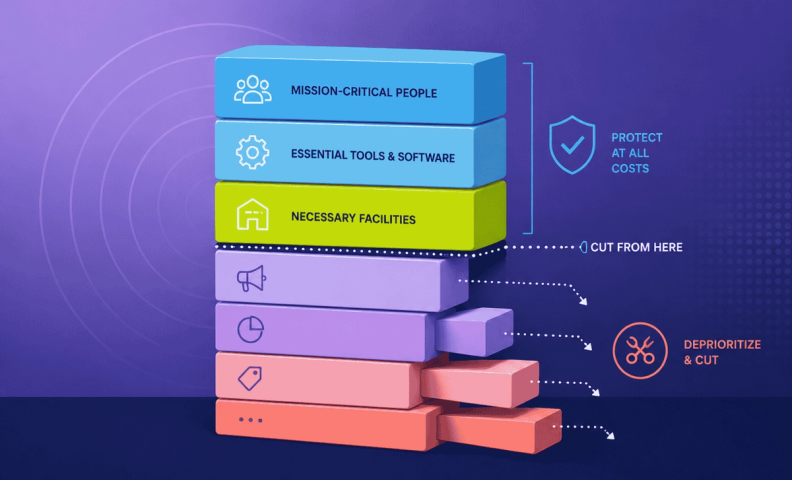
Cutting costs without a framework is how businesses accidentally cut the wrong things: the marketing channel that's actually working, or the software subscription that's saving three hours a week. Before you touch anything, you need a way to tell what's actually safe to cut from what's protecting your ability to keep operating. This guide walks through that decision process in four steps:
- Identify which costs actually produce revenue
- Use ratios to spot what's out of line
- Protect what's mission-critical
- Prioritize what's left to cut
Understanding revenue producing costs
Some costs are essential to producing revenue. When looking at cost optimization, you'll want to look at these revenue-producing costs. These costs generally include the following:
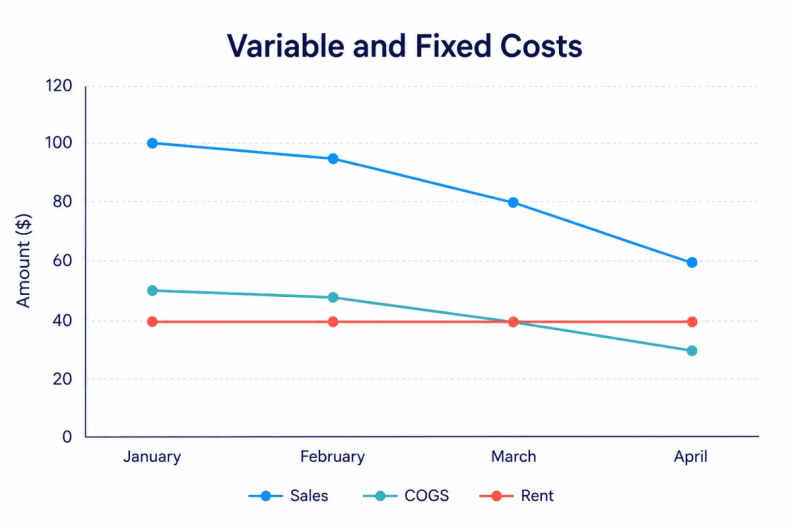
- Cost of goods sold: Direct costs of producing the product sold
- Customer acquisition costs: Costs needed to acquire a customer (marketing expenses)
These costs are variable and generally move up and down with sales. Fixed costs (overhead), on the other hand, are usually less essential to producing revenue and remain constant as sales move up or down:
Contribution margin
A key number to track is your contribution margin, sale price minus all variable costs tied to that sale (product cost, warehousing, shipping, customer acquisition). It should stay roughly constant regardless of sales volume. If this number isn't healthy, you're scaling a loss, and growing faster only means losing money faster.
Contribution Margin = Sale Price – Variable Costs
Read for the tactics to actually improve this number, pricing adjustments, SKU rationalization, supplier renegotiation.
Break-even point
After understanding variable and fixed costs, a company should calculate and know their break-even point. This calculation will tell you how many products you need to sell to cover your fixed costs.
Break-even point (# of units needed to sell) = Fixed costs / Contribution margin
Let's say your break-even point is 50 units. If you’re selling less than this number, you'll need to reduce fixed costs or increase the number of units sold. Adjusting contribution margins is more difficult but can be done over time.
Tier and adjust costs with sales ratios
Another way to analyze and look at cost optimization is through income or revenue ratios. This method looks at every expense category as a percentage of income, which cuts through the noise and keeps you from getting hung up on raw numbers. Key ratios to track are COGS and gross profit, then your net operating ratio and net income ratio.
For the specific healthy ranges we typically see across fulfillment, marketing, COGS, and payroll, see the benchmarks in our 8 Ecommerce Cost Cutting Strategies guide.
It's important to categorize and organize expenses in a way that makes these ratios easy to review and creates accountability. At LedgerGurus, we divide expenses into categories, and in addition, functions or departments.
What's a good ratio for each expense category? It depends on:
- Industry: Every industry has its own standards
- Company size: Ratios differ between small, medium, and large companies
- Stage: Good ratios differ when you're in growth, maintenance, or survival phases
When setting your ratio goals, we suggest looking at historical performance, industry best practices, and your company's own targets.
Protect/scale critical operating costs
When looking at cost optimization, examining your mission-critical costs is important. Basically, what costs do you need to keep your business running? You need to protect sales and other critical costs:
- People
- Tools (GSuite/Office365, truck for a plumber)
- Facilities (office, warehouse)
When it comes to payroll specifically, think beyond simple headcount cuts. Restructuring roles often protects the business better than layoffs. Remember to think outside the box and explore alternatives:
- People: pay cuts versus layoffs, hiring an assistant versus adding a role (empower a high performer)
- Tools: equivalent alternatives, annual versus monthly subscriptions, used versus new
- Facilities: rent vs. own, sub-leasing
Prioritize non-critical costs
Once you’ve identified critical costs, you should have a list of non-critical costs left over. Then you can prioritize, for example, ranking all your software. If you’ve identified a ratio goal for software, you can reduce, eliminate, or downgrade whatever sits at that ranking until you hit your target.
Your ratio goals can then turn into your budget. Every highly successful company operates against a budget. Small businesses tend to skip this and instead budget off bank balances, which can turn bad real fast.
Here’s a story of one of our clients who used to do just that and how we helped him base his decisions on a solid financial picture instead.
To bring it all together, approach cost optimization this way: Budget (with ratios) → Control → Measure → Adjust. We follow this at LedgerGurus. It takes time to build, but it pays off in the long run.
Frequently asked questions
What's the difference between revenue-producing costs and fixed costs?
Revenue-producing costs, like Cost of Goods Sold and customer acquisition costs, are variable and move up and down with sales. Fixed costs (overhead) stay constant regardless of sales volume and are generally less essential to producing revenue directly.
What is contribution margin and why does it matter?
Contribution margin is your sale price minus all variable costs tied to that sale (product cost, warehousing, shipping, customer acquisition, etc.). It should stay roughly constant no matter how many units you sell, which makes it the number to protect first during tough times, rather than chasing revenue at any cost.
How do I calculate my break-even point?
Break-even point equals fixed costs divided by contribution margin. It tells you exactly how many units you need to sell to cover your fixed costs. If you're below that number, you either need to reduce fixed costs or increase sales volume.
Why should I look at expenses as ratios instead of dollar amounts?
Viewing every expense category as a percentage of income cuts through the noise of raw numbers and makes it easier to spot which categories are actually out of line, compared against your own historical performance, industry norms, or your company's targets.
How do I decide which costs to cut first?
Start by protecting mission-critical costs, key people, essential tools, and necessary facilities, and look for creative alternatives before cutting them (like pay cuts instead of layoffs). Then rank everything else and cut from the bottom of that list first, working up until you hit your ratio targets.
Where do I go for the specific benchmarks and tactics?
8 Ecommerce Cost Cutting Strategies covers the exact healthy ranges by category and walks through actionable tactics for fulfillment, marketing, payroll, and more.
Get the numbers to back your cost decisions
Knowing your contribution margin, break-even point, and expense ratios only helps if your books are structured to show them clearly. LedgerGurus can help you build that reporting and bring CFO-level insight to the budget, control, measure, adjust cycle, so cost optimization becomes a repeatable discipline instead of a one-time scramble.
