

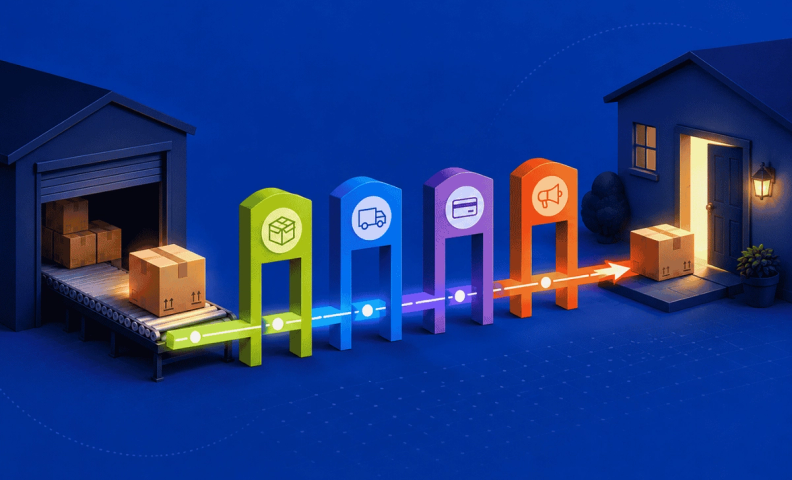
Most sellers can tell you their COGS off the top of their head. Fewer can tell you their actual Cost of Sales, and that gap is exactly where margin problems hide. This guide draws a clear line between the two, walks through the four things that actually belong in Cost of Sales for an ecommerce business, and shows you where to look for the costs that quietly get missed.
What is Cost of Sales?
Cost of Sales (COS) is the cost directly tied to selling a product or providing a service. People often use "Cost of Sales" and "Cost of Goods Sold (COGS)" interchangeably, but for ecommerce sellers, it's worth keeping them separate.
COGS is everything it costs to get your product made and into your warehouse: materials, production, and inbound freight, and includes your landed costs. For more information, read up on calculating and recording COGS for ecommerce business.
Cost of Sales is everything it costs to get that product from your warehouse into your customer's hands and turn it into a sale. For ecommerce, that means packaging, shipping and delivery, payment processor fees, and marketing and advertising.
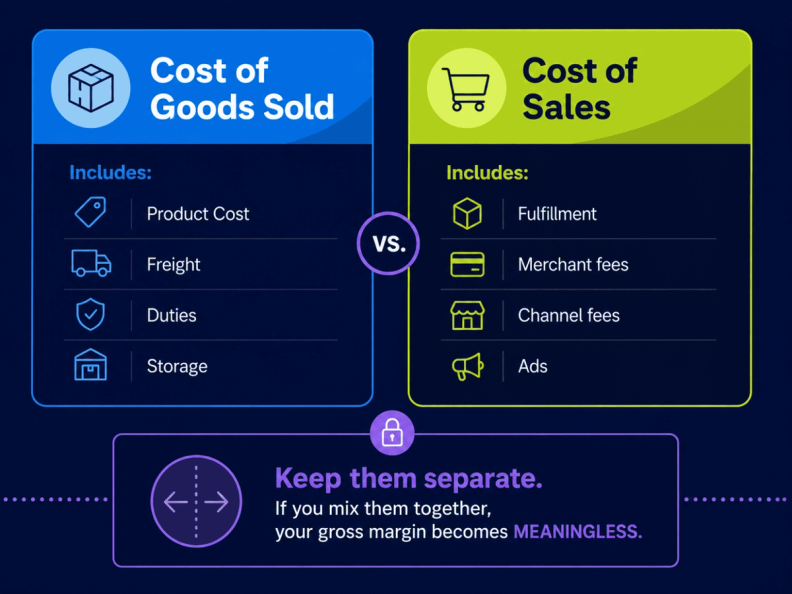
Cost of Sales components for ecommerce sellers
For ecommerce specifically, Cost of Sales includes:
- Packaging: Protection, branding, and unboxing experience, from boxes to bubble wrap
- Shipping & delivery: Whether you offer free shipping or charge for it, getting the product to the customer's door has a cost
- Payment processor fees: The per-transaction cut taken by PayPal, Amazon Pay, Shopify Pay, or your credit card processor, small individually, but it adds up
- Marketing & advertising: Your Facebook and Google ad spend plays a direct role in making the sale, which makes it part of Cost of Sales too, not just a separate marketing line
These are separate from COGS, which covers getting the product made and into your warehouse. Together, COGS and Cost of Sales make up the full picture of what it costs you to turn inventory into revenue, and the Cost of Sales categories here are the same ones that drive your contribution margin. Here’s a video explaining the difference between COGS and Cost of Sales in more detail.
Identifying and tracking Cost of Sales correctly
Getting clean Cost of Sales data starts with making sure each category is actually categorized as Cost of Sales, not buried somewhere else in your books. A few common tracking mistakes:
- Payment processor fees get lumped into "bank fees" or "merchant fees" as a generic overhead line, instead of being tracked as their own Cost of Sales category tied to sales volume.
- Shipping costs get netted against shipping income rather than recorded as a full expense, which hides the true cost of getting orders out the door.
- Marketing spend gets recorded in the period the invoice hits, rather than the period it actually drove sales, which makes it hard to tell whether a campaign was actually profitable.
- Packaging costs get grouped into general supplies instead of being tracked as Cost of Sales, so they never show up in margin analysis at all.
If any of these are happening in your books, your Cost of Sales numbers will look artificially low, and your real margins are worse than they appear.
Breaking out Cost of Sales by product, channel or client
Once you're tracking Cost of Sales accurately, break it out further so you can see where it's actually being spent.
For product businesses, look at Cost of Sales by SKU or by sales channel:
- Packaging and shipping cost per order (larger or heavier items cost more to ship)
- Payment processing fees by channel (Amazon's referral fees differ from Shopify's payment processing rate)
- Marketing spend attributed to specific product lines or campaigns using UTM tracking.
For service businesses, look at Cost of Sales by client or project:
- Sales commissions paid to close a deal
- Referral fees
- Payment processing fees on invoices
- Marketing spend by lead source
This level of detail is what lets you see which products, channels, or accounts are actually profitable, rather than judging profitability at the whole-business level, where a few bad performers can hide inside otherwise healthy numbers.
Finding hidden Cost of Sales
Some Cost of Sales costs are easy to spot. Others quietly get absorbed into general overhead, where they distort your real margins. Common ones we see:
- Chargebacks and dispute fees, on top of the sale you already lost.
- Giveaways and free gifts with purchase, especially when a marketing team hands these out without accounting flagging the cost.
- Affiliate and influencer commissions
- Retargeting and remarketing ad spend, which sometimes gets tracked separately from "core" marketing and forgotten.
- Cart abandonment and email marketing tool costs, when they're specifically driving sales rather than general communication.
Note: inbound freight and tariffs on the product itself are COGS, not Cost of Sales, so don't double-count them here.
Strategies for Cost of Sales optimization
Once you can see your Cost of Sales clearly across all four categories, you can optimize each one directly:
- Packaging: Right-size boxes, use multi-use materials across SKUs, and negotiate with suppliers as volume grows
- Shipping & delivery: Renegotiate carrier rates, adjust your free-shipping threshold, and reconsider warehouse location relative to your customer base
- Payment processor fees: Negotiate lower rates at higher volume, and evaluate lower-fee payment methods where it makes sense for your customers
- Marketing & advertising: Cut low-ROAS spend, shift budget toward proven channels, and renegotiate agency retainers
For a deeper playbook on each of these levers, our 8 Ecommerce Cost Cutting Strategies guide goes much further into the specifics.
As you make these changes, don't "dilute the soup." Cost of Sales is directly tied to the value you deliver, so cutting packaging quality, shipping speed, or marketing reach too aggressively can cost you more in lost sales than it saves.
Final thoughts
Getting Cost of Sales right starts with keeping it separate from COGS, tracking it accurately by category, and breaking it out by product, channel, or client so you can see where it's actually going.
From there, optimization is a long-term, ongoing process, not a one-time fix. Your Cost of Sales will shift as your business grows and changes, so keep revisiting it.
Frequently asked questions
What's the difference between Cost of Sales and COGS?
COGS is everything it costs to get your product made and into your warehouse, materials, production, inbound freight. Cost of Sales is a separate category. It is everything it costs to get that product out of your warehouse and into a customer's hands, like packaging, shipping, payment processor fees, and marketing and advertising.
What counts as Cost of Sales for an ecommerce business?
Packaging, shipping and delivery, payment processor fees (PayPal, Shopify Pay, credit card fees, etc.), and marketing and advertising spend. The direct cost of the product itself falls under COGS, a separate category.
Why does accurate tracking of Cost of Sales matter?
If payment fees, shipping, marketing, or packaging get buried in generic overhead categories instead of tracked as Cost of Sales, your margins will look better than they actually are, and you won't be able to tell which products, channels, or clients are truly profitable.
What are examples of hidden Cost of Sales?
Chargebacks, giveaways and free gifts, affiliate or influencer commissions, and retargeting ad spend are all commonly missed because they get absorbed into general overhead instead of tracked as Cost of Sales.
How can I optimize Cost of Sales without hurting the customer experience?
Focus on negotiating better rates (carriers, payment processors, suppliers) and shifting spend toward what's working (proven marketing channels, right-sized packaging), rather than cutting quality, shipping speed, or marketing reach so much that it costs you sales.
Get Cost of Sales data you can actually trust
Optimization only works if your Cost of Sales is tracked accurately and separated from COGS in the first place. LedgerGurus can help you build the SKU-level, channel-level, and client-level tracking that reveals your true margins, so every decision you make is based on real numbers.
