

Accounting is the last thing a lot of ecommerce business owners want to think about. We get it. Accounting is boring and tedious. But better accounting can take your business from good to great. On the other hand, bad accounting can hide a slew of financial problems that destroy businesses. So, if DIY accounting is your current method, consider and be wary of the common mistakes detailed in the rest of this blog.
Mistake #1: Bookkeeping errors that look like fraud
This is a given. Owners attempting DIY accounting will make bookkeeping errors. Frankly, seasoned professionals will make errors too. Sometimes these errors don't really matter. Other times, these errors can look like fraud during an audit. Errors will also give you poor financial data, leading to bad business decisions, because they are based on wrong financial numbers.
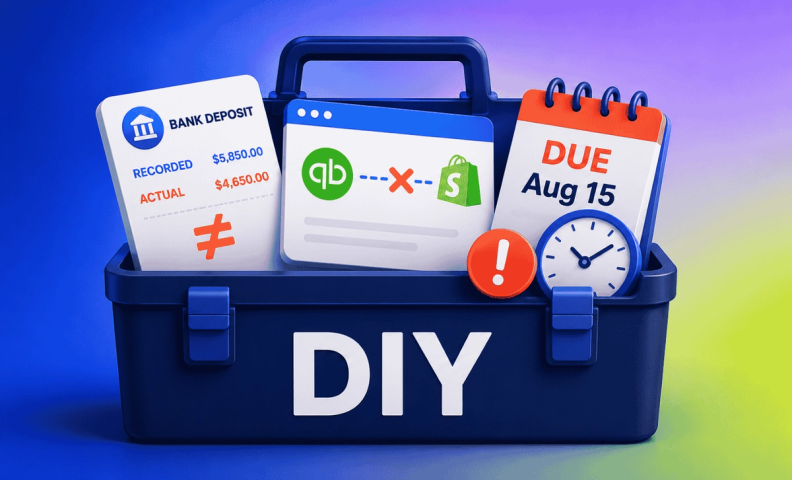
The most common version of this we see in ecommerce specifically: recording the deposit that hits your bank account as your total sales. That deposit is actually a net number, sales minus fees, refunds, chargebacks, and shipping, all bundled together. Treat it as revenue, and every report built on top of it is wrong. (We cover this in detail in 3 accounting basics for Shopify sellers.)
Mistake #2: Trusting software to catch everything
Business owners are trying to automate and streamline as many processes as possible. Accounting software can allow for automation. These software products often advertise themselves as DIY accounting software, but beware! Sometimes accounting software isn't perfect, or it doesn't do everything that you need it to. In addition, integrating accounting software with other apps can create BIG problems and hours of fixing complicated issues. (For more information, read about when to integrate QuickBooks Online with other apps.)
Here's what this looks like in practice: an integration between your sales channel and QuickBooks silently stops syncing for three weeks. Nobody notices because the software isn't designed to tell you when it's not working, only when it is. By the time someone catches it, you're reconciling months of missing transactions by hand. Software failures like this are exactly why inventory and accounting systems need a human checking the output, not just trusting the automation.
In the end, you need a close eye on everything your accounting software is doing, either your eye or someone else's. The more experienced this eye is in accounting (specifically accounting in your industry), the better. They can save you hours of time by setting up your accounting technology ecosystem in the correct way and constantly double checking everything that is happening.
Mistake #3: Bill management shortcuts that invite embezzlement
Oh, the bane of every business owner's existence. Staying on top of bills is no easy task. As bill management becomes complicated for a business, a couple of things tend to happen:
- Business owners forget to pay bills. This will cost the business unnecessary fees.
- Business owners expose their business to embezzlement. Business owners take shortcuts in the bill management process. Shortcuts may include signing blank checks, giving one person the ability to approve and send checks, and other risky behavior.
We've seen too many small businesses embezzled by an employee. Mind you, this employee is usually very well trusted by the business owner!
This isn't a rare, hypothetical risk. Occupational fraud costs the average small business a median of $150,000 per incident, and the businesses hit hardest are almost always the ones with no separation of duties: one person requesting, approving, and sending payments. Even basic controls, like requiring a second approver on payments over a certain amount, close most of this gap.
Click here to read about how to protect your business with quality bill management processes.
Mistake #4: Missing deadlines that cost you in penalties
When a business owner is attempting DIY accounting, the chances of missing deadlines increase dramatically, and we don't blame them! Business owners are busy with important to-dos and tasks. This often leads to missing accounting deadlines, such as remitting sales tax, paying bills, filing taxes, and more. And missing deadlines equals unnecessary costs.
This shows up most often with sales tax. A state can change your filing frequency (quarterly to monthly, for instance) without much warning, and if you're not watching for the notice, you miss the new deadline entirely. We've seen a $20,000 sales tax balance grow to $28,000-$32,000 once penalties and interest compound, see how fast past-due sales tax penalties add up for the full math. Quarterly estimated tax payments and 1099 filing deadlines are two other common ones DIY business owners lose track of.
Mistake #5: Spending more time than you're saving
With DIY accounting, you will most likely be spending more time than an accounting expert would. Mistakes may lead to hours of fixing problems. Or the learning curve for a new area of accounting may take up A LOT of time.
So, you should ask yourself some questions:
- How much is your time worth?
- What other things could you be doing in your business to decrease costs or increase revenue?
- Are you prone to the mistakes mentioned in this article?
- Is DIY accounting really worth it?
- What options do you have available to meet your accounting needs and allow you to spend your own time where it's most valuable?
Business owners doing their own books often underestimate the real time cost: research suggests small business owners spend an average of several hours a week on bookkeeping and related admin, time pulled directly from sales, product, or marketing work. If your time is worth more per hour running your business than the cost of outsourcing your books, the math usually favors handing it off, even before counting the cost of the mistakes above.
If you're ready to start outsourcing your ecommerce accounting, let us know. Our ecommerce accounting experts can take care of it for you, freeing you up to do the important work on running and growing your business.
Frequently asked questions
Are bookkeeping errors really that big a deal if I catch them eventually?
Sometimes they're harmless, but other times they can look like fraud during an audit, or lead to bad business decisions built on inaccurate numbers. Catching them "eventually" often means you've already made decisions based on wrong data.
Can't accounting software just handle everything for me?
Not entirely. Software automates a lot, but it isn't perfect, and integrating multiple tools can create real problems that take hours to untangle. You still need an experienced eye watching what the software is actually doing.
What's the biggest bill management mistake small businesses make?
Taking shortcuts to save time, like signing blank checks or letting one person both approve and send payments. Those shortcuts are exactly what create embezzlement risk, often from an employee the owner trusts completely.
What happens if I miss a sales tax or tax filing deadline?
You'll likely face penalties and added costs, and if it becomes a pattern, it increases your risk during an audit. DIY accounting makes missed deadlines more likely simply because business owners are busy with other priorities.
How do I know if DIY accounting is actually costing me more than it's saving?
Ask how much your time is worth, what else you could be doing to grow revenue or cut costs, and honestly whether you're prone to the mistakes above. If fixing errors or learning new accounting tasks is eating significant time, DIY is likely costing you more than it looks like on paper.
Stop losing time (and money) to DIY accounting
If any of these five mistakes sound familiar, that's a sign it might be time to hand your books to someone who does this every day.
Our ecommerce accounting experts can take it off your plate entirely, freeing you up to focus on running and growing your business.
