

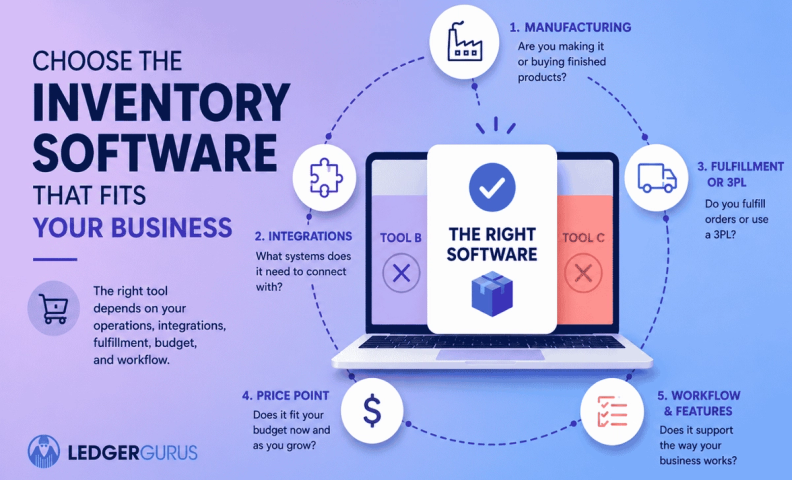
Knowing how to choose an inventory management tool is crucial. According to Yahoo Finance, “Each year, retailers and ecommerce businesses worldwide lose a monstrous $1.77 trillion due to the cost of out-of-stocks, overstocks, and excessive returns.” Many of these problems can be minimized by choosing and using the best inventory management software or tool for your business.
The struggles of inventory management
At LedgerGurus, we see firsthand how our clients often struggle with inventory management and the impact it can have on their bottom line. We also see how blind they feel when trying to:
- Understand their costs
- Know where inventory currently is
- Keep track of correct quantities
- Keep a handle on what's coming and going
These problems not only cause pain for our clients, but also make it harder for us to support them on the accounting side.
Many businesses rely on spreadsheets to manage everything, but run into human errors, time consuming processes, and workflows that are just not well supported with spreadsheets. As businesses and operations become more complex and disorganized, they encounter inventory chaos, losing visibility into their most important asset. This causes extreme frustration as they have less and less confidence in where they stand.
Enough is enough. Today's market has undergone a huge transformation with many more tools that are available for automation and process improvement. These tools provide support around necessary workflows, reducing time spent, human error, and overall frustration. Inventory management systems can make life easier and make businesses more profitable, but choosing the right tool can be overwhelming. We help our clients select & implement tools every day, so we can tell you a bit about how to select the right tool.
Let's start by briefly reviewing just what an inventory management software tool is and list just a few of the many that are out there.
What is inventory management software?
Inventory management software, or tools, manage inventory in one or more locations to ensure that it's in the right place, at the right time, and in the right quantity. It keeps track of the costs associated with inventory as it sells to give you a good cost of goods sold number, as well as tracks the value of inventory still on hand and on order. It may also help you keep track of key metrics like inventory turnover, re-order points, and might even assist with forecasting, depending on the tool.
Some inventory tools will help you establish and track manufacturing processes and assist in warehouse management. Most inventory tools will integrate directly with your sales channels, so you can get this data in real time and make decisions in a timelier way.
What inventory tools are there?
There are many inventory tools available in the market, as many as there are fish in the sea. Well, not really, but it can sure feel that way sometimes.
Here are four examples of inventory management tools for ecommerce we currently implement, chosen for their positioning in the market, price point, and features, but this list is far from comprehensive.
All these tools are cloud-based, and that is by design. We would not even consider an inventory tool for an ecommerce business that wasn't online. Your business is online. Why would you take 20 steps backwards with a desktop inventory management tool?
How do I choose the best inventory management software for my business?
There are five major considerations you should consider when choosing an inventory tool.
Consideration #1: Are you doing your own manufacturing or buying a finished product?
Many ecommerce businesses these days outsource their manufacturing. Manufacturing is a major feature of many inventory tools, but those tools will often cost more, be more complex to use, and have a steeper learning curve. You can avoid all that completely if you don't manufacture. If you do manufacture, though, this should be consideration #1 to ensure your workflow can be easily captured in this tool and you can get good cost data using it.
Consideration #2: What integrations does the tool offer?
One of the major advantages of an inventory tool is immediate information updates when items sell or during other steps along the way. That advantage is only available to you if your tool integrates with your sales channels, your accounting system, your shipping tool, your 3PL, and any other critical pieces involved in your workflow.
Consideration #3: Are you doing your own fulfillment or using a 3PL?
Like manufacturing, warehouse management and fulfillment are a major feature of many inventory tools. If you are using a 3PL for all your sales, this functionality is something you don't need at all. Why pay for all that if you don't need it? If you do need this, though, it should be a major consideration again.
Consideration #4: What is your price point?
Inventory tools can be wildly expensive, with all the whistles and bells, or very affordable. The cheapest price point we have seen is free with limited orders and functionality before they start to charge. Or it can cost many thousands of dollars per month.
Before you automatically shy away from expensive, keep in mind that most inventory tools are significantly less expensive than an ERP (Enterprise Resource Planning) like NetSuite, but will often solve 95% of a company's woes if they choose the right one. We have seen MULTIPLE companies reach a point of desperation and spend many tens of thousands implementing an ERP way before they needed one because they went cheap on inventory tools or never implemented one at all.
Also consider whether the tool is priced on volume, connections, or number of users. Don't pick a tool that will price you out of it as you grow.
Consideration #5: Features and workflow
One of the biggest reasons to adopt an inventory tool is to improve your processes, workflow, and accuracy of data. This can either be a big win or a big failure, depending on whether your tool actually accommodates those workflows. We saw one of our clients completely abandon an expensive implementation after paying lots of money because it turned out the tool would not accommodate a critical workflow. This was NOT an implementation we were doing, but I assure you it's a consideration that should have been considered right from the beginning. (We never worked with that implementer again!)
Other things that would fall into this category would be:
- Whether the tool accommodates multiple warehouses
- How much sales volume the tool can handle
- How many users you need
Frequently asked questions
How much money do inventory mistakes actually cost businesses?
According to Yahoo Finance, retailers and ecommerce businesses worldwide lose a combined $1.77 trillion each year to out-of-stocks, overstocks, and excessive returns, much of it avoidable with the right inventory tool.
What does inventory management software actually do?
It manages inventory across one or more locations to keep the right stock in the right place at the right time, tracks the cost of inventory as it sells to give you an accurate COGS number, and often supports inventory turnover tracking, reorder points, and forecasting.
What's the most important factor in choosing an inventory tool?
It depends on your business, but the biggest cost and complexity driver is usually whether you manufacture your own products. Manufacturing features add cost and a steeper learning curve, so if you don't manufacture, you can skip tools built around it entirely.
Should I choose a cheap or expensive inventory tool?
Don't rule out a pricier tool just because of cost. Most inventory tools are significantly less expensive than an ERP like NetSuite and can solve the vast majority of a company's inventory problems if you pick the right one. Going too cheap, or skipping a tool altogether, often leads to a much more expensive ERP implementation down the road.
Why should my inventory tool be cloud-based?
Your business is already online, and a desktop-based inventory tool creates unnecessary friction and limitations. LedgerGurus wouldn't consider a non-cloud-based tool for an ecommerce business for this reason.
Let us help you choose the right too
Picking the right inventory tool is only half the battle, implementing it so it actually solves your workflow problems is the other half. We've seen companies waste tens of thousands of dollars on the wrong tool, or on an ERP they didn't need yet, because this step got rushed. LedgerGurus helps ecommerce businesses select and implement the right inventory management software from the start, so you don't have to learn these lessons the hard way.
