

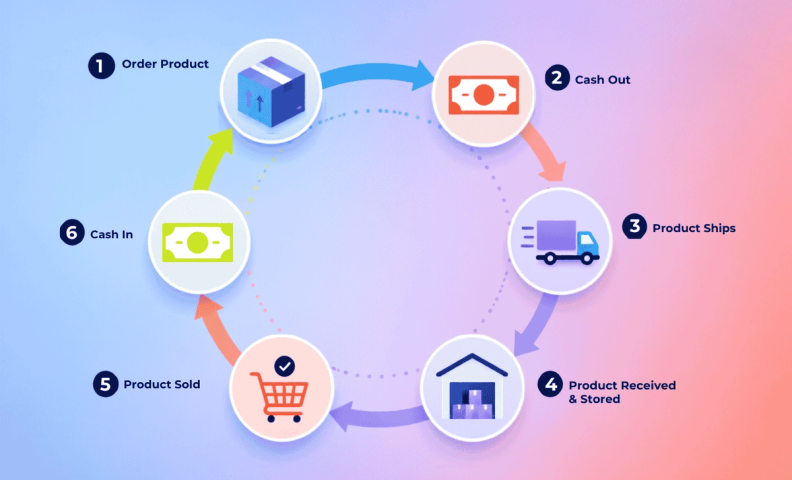
For ecommerce brands, inventory turnover is one of the most telling numbers you can track. It shows how quickly your products sell, how effectively you manage stock, and how much money you can reinvest into scaling.
If you’d like to watch the related YouTube video, here it is:
Why inventory turnover is one of your most important numbers
Inventory is an ecommerce business's biggest asset, and inventory turnover tells you how well you're managing and moving it. Specifically, it measures your average amount of inventory against how many times you sell through it in a given period.
Higher numbers are generally better because they indicate lower "holding" costs, stronger profitability, and less of your capital tied up sitting in a warehouse instead of working for you. That means more cash available to put into marketing, new products, or anything else that grows the business. (For a deeper look at how your inventory cycle connects to your cash position, see our guide on managing cash flow through understanding your inventory cycle.)
Here's an example: Let's say that your company sells athletic shoes. In a given year, you typically sell 1,000 pairs of shoes, with 250 pairs of shoes in stock at a time. You find your inventory ratio by dividing total pairs of shoes by average pairs of shoes (1,000:250 → 4:1 ratio → Inventory Turnover Ratio of 4).
You'll want to check your industry standards to see what a good inventory turnover ratio is, but typically 4-6 is good to shoot for.
One important caveat: higher isn't always better. If your turnover ratio is unusually high, it can actually be a sign you're understocking and losing sales to stockouts, not necessarily a sign of great inventory management. (For more on avoiding that trap, see our guide on preventing inventory stockouts.) The goal is a healthy ratio for your industry and business model, not the highest number possible.
How to calculate your inventory turnover ratio
Simply put, Inventory turnover = COGS / Average inventory. Determining your inventory turnover is easily done when you’re accurately calculating Cost of Goods Sold (COGS) for your business. There are a few steps involved in getting there.
Step 1: Determine your COGS for a given period of time (usually a year). There are several places to pull this from:
- Inventory management software, if you're using it.
- Your income statement under the COGS section (it's REALLY important to make sure this is being recorded accurately.)
- Your balance sheet: Beginning inventory + Net inventory purchases – Ending inventory
It is astonishing how many ecommerce companies are calculating and recording their COGS incorrectly. If you want to check your own numbers against common mistakes, Why Your COGS Numbers Are Probably Wrong (+ 5 Ways to Fix Them) is a good place to start, along with Cost of Goods Sold for Ecommerce (COGS): Key to Business Success
Step 2: Determine your average inventory. Average inventory = (Beginning Inventory + Ending Inventory) / 2
Step 3: Divide COGS by average inventory.
How to improve your inventory turnover ratio
So, how do you make your turnover ratio better? A few concrete levers to pull, with an example of each:
Run a well-calculated promotion. Check the numbers before you do, though, and make sure the ROI actually makes sense. For example, if you're sitting on 200 units of a slow-moving SKU, running a 20%-off promotion only makes sense if the margin on the remaining 80% still covers your holding costs and then some, not just if it clears the shelf.
Adjust your purchasing frequency. Can you buy less, more often? If you currently order a 6-month supply of a SKU twice a year, switching to ordering a 2-month supply six times a year keeps less capital tied up in inventory at any given moment, improving your ratio without changing a single sale.
Revisit your product pricing. Are you priced competitively while still protecting a good margin? A small price adjustment on a slow-moving SKU can be the difference between it selling steadily or sitting in the warehouse for months.
Double down on what's actually selling. If one SKU is turning over quickly and another is barely moving, shift more of your purchasing budget and marketing attention toward the winner instead of splitting resources evenly.
Watch your trends. Digging into seasonal or demand trend data helps you anticipate which inventory will turn over and when, so you're not caught overbuying right before a slowdown or underbuying right before a spike.
For a broader look at inventory optimization strategy beyond just turnover, see Why Inventory Optimization Is Critical.
For more ecommerce KPIs, in addition to inventory turnover, download our Ecommerce KPIs Report.
Frequently asked questions
What is a good inventory turnover ratio?
It varies by industry, so check your specific benchmarks, but a ratio of 4-6 is typically a good target for most ecommerce businesses.
How do I calculate inventory turnover?
Inventory Turnover = COGS ÷ Average Inventory. First determine your COGS for a given period (usually a year), then calculate average inventory as (Beginning Inventory + Ending Inventory) ÷ 2, then divide.
Where do I find my COGS number to calculate turnover?
You can pull it from inventory management software if you use one, from the COGS section of your income statement, or calculate it from your balance sheet as Beginning Inventory + Net Inventory Purchases − Ending Inventory. Just make sure it's being recorded accurately, since many ecommerce companies get this wrong.
What's the fastest way to improve my inventory turnover ratio?
There's no single fastest fix, but the highest-leverage levers are usually adjusting purchasing frequency (ordering less, more often), reviewing product pricing, and doubling down on your best-selling SKUs while reconsidering slow movers.
Why does a higher inventory turnover ratio matter for my business?
A higher ratio generally means lower holding costs, stronger profitability, and more cash freed up to reinvest in marketing and growth, since your capital isn't sitting tied up in unsold inventory.
Get your inventory numbers right
Improving your inventory turnover starts with trusting the numbers behind it, especially your COGS and average inventory. If those aren't accurate, neither is your turnover ratio.
LedgerGurus specializes in ecommerce accounting and inventory, and we can help make sure your numbers are right so you can actually act on them.
