


Picture this: You're an ecommerce seller managing multiple channels, juggling multiple products, and trying to keep up with the ever-fluctuating customer demand. Then it happens, the dreaded overselling scenario: you run out of inventory for a popular product right as orders are pouring in. Now you're dealing with frustrated customers, lost sales, and a dinged reputation, just a few of the headaches that come with stockouts.
If that sounds familiar, you're not alone, this is one of the most common problems ecommerce businesses face. This guide walks through why it happens, what it actually costs you, and 14 concrete tips to prevent it, including tools like inventory forecasting and, when it makes sense, an inventory management system.
What counts as overselling?
Overselling, or a stockout, happens when you have more orders for a product than you have inventory to fill them. The result: customers left with empty carts and a poor shopping experience. Keeping ecommerce inventory numbers accurate is a constant struggle, and overselling is especially common for sellers using Fulfilled by Merchant (FBM) on Amazon.
So why does it happen? Here are the most common culprits.
7 common causes for ecommerce overselling
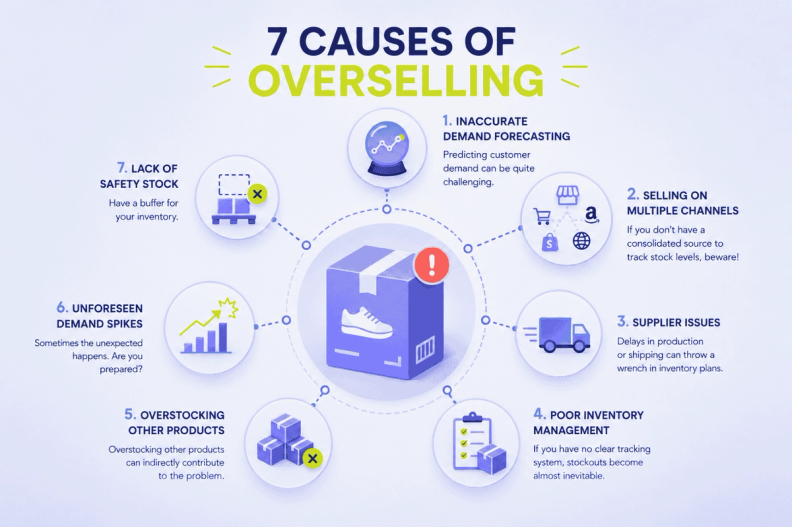
Your inventory numbers can get thrown off for all kinds of reasons, a customer buys something in your brick-and-mortar store and it doesn't get reflected on Amazon or Shopify, for example. Here are the seven we see most often.
Inaccurate demand forecasting
Predicting customer demand is a bit like predicting the weather. Sometimes you nail it, sometimes you don’t. Seasonal fluctuations make this even trickier. Products with big seasonal swings in demand will oversell during peak periods if your inventory plan doesn't account for it.
Selling on multiple channels
If you sell on more than one channel without a consolidated source to track stock levels, overselling becomes a recurring problem. Without a good central system, pending orders often don't decrement inventory levels properly, leaving you with numbers you can’t trust.
Supplier issues
Delays in production or shipping can throw off your entire inventory plan. We've dealt with this firsthand with our own ecommerce store, Sole Toscana, and it's taken real effort to keep product flowing in before the next shipment runs out.
Poor inventory management
Without a clear tracking system, stockouts become almost inevitable. If you can't accurately track what's in your warehouse, you end up guessing when you post available stock to Amazon or other channels, which becomes a serious problem if it costs you the Buy Box.
Overstocking other products
While your attention is usually on not running out of your best sellers, overstocking elsewhere can indirectly contribute to the problem too. It's a balancing act.
Unforeseen demand spikes
Sometimes, the unexpected happens, like a viral trend, a celebrity mention, a sudden shift in the market, and demand spikes with no warning. Are you prepared for that?
Lack of safety stock
Safety stock is your buffer, a safety net for your inventory. Without enough of it, you’re exposed every time something unexpected happens.
What overselling actually costs you
Overselling isn't a minor inconvenience. It comes with a real price tag. Every stockout risks lost sales, lost customer trust, and lost future business, and those costs compound quickly.
On Amazon specifically, overselling can tank your seller rating, generate negative reviews, knock you out of the Buy Box, and in serious cases put your account at risk of suspension.
14 tips to prevent overselling
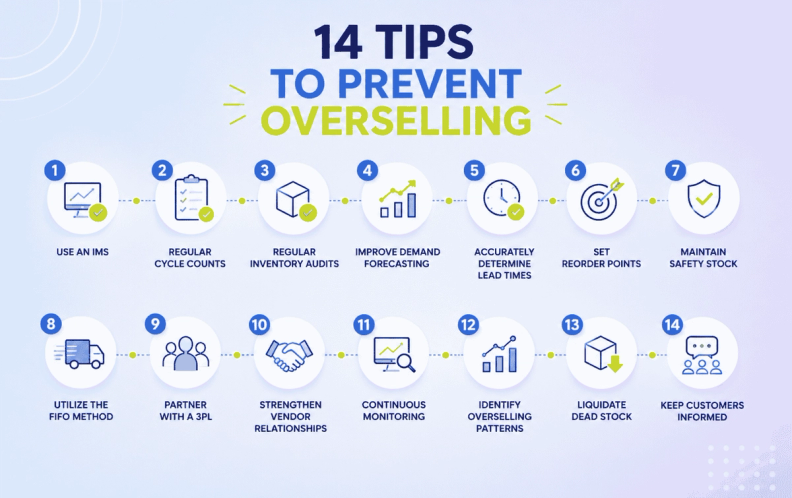
1. Use an Inventory Management System
The single highest-leverage fix: implement an inventory management system. Think of it as GPS for your inventory, everything lives in one place, and every channel pulls from the same real-time source. Sell an item on Etsy, and your Amazon listing updates automatically. That single source of truth means clearer numbers for operations, accounting, and purchasing alike, and it directly prevents overselling.
Even single-channel sellers benefit, real-time visibility into your stock is valuable no matter how many channels you're on. For more on the case for one, see The Top 10 Benefits of an Inventory Management Software.
2. Complete regular cycle counts
Cycle counts (systematically counting a rotating subset of your inventory) are one of the most effective habits you can build, especially for your most popular, highest-value, or historically error-prone SKUs. Done daily or weekly, they catch discrepancies before they compound. For more on what causes those discrepancies in the first place, see Causes of Stock Discrepancies: Why Your Inventory Count Is Off.
3. Carry out regular inventory audits
Cycle counts and full inventory audits aren't the same thing. An audit is a comprehensive, less frequent process, counting and reconciling everything at once to get an accurate snapshot for financial reporting or compliance. It takes more time and more people, but it's worth it to know exactly what you actually have on hand.
4. Improve demand forecasting
The next 3 tips work quite nicely together.
Start by analyzing historical sales data and market trends to predict what you'll need and when. If you sold X units last year and you've grown Y% this year, that gives you a reasonable target for this year and next. It's not an exact science, but it beats guessing. If you're not on an IMS yet, our free Inventory Forecasting Template can help. We built it originally for our own ecommerce company, and it's helped plenty of our accounting clients too.
5. Accurately determine lead times
Work closely with suppliers to understand how much lead time to expect for deliveries, and see if there's room to shorten it. This is trickier than it sounds, since you have to account for manufacturing time and transit time together.
6. Set reorder points
Establish a stock threshold that automatically triggers a reorder. Once you hit it, you know it's time to order before you run out. You can do this manually with the Inventory Forecasting Template, or let an IMS handle it: most have native reorder functions that notify you (or auto-generate the order) once you hit your threshold. Dedicated purchasing and forecasting software can layer on even more analytical depth on top of your IMS.
7. Maintain safety stock
Even with the first three steps dialed in, the unexpected still happens, a supply chain disruption, a sudden demand spike. Keeping a buffer of extra inventory, especially for your most popular products, is what gets you through those moments without a stockout.
8. Utilize the FIFO method
First-In, First-Out means older stock sells before newer stock, reducing the risk of obsolete or expired inventory. It's especially valuable for products with shelf lives, expiration dates, or version changes over time (electronics, fashion), since customers get the most current version rather than something that's been sitting around. It's also simple to implement without complex software, and it improves both holding costs and stock turnover.
9. Partner with a 3PL
A Third-Party Logistics provider adds warehousing capacity, more efficient storage, and scalability as you grow. 3PLs help maintain accurate stock levels, prevent overselling, and typically excel at fast, efficient order fulfillment, freeing you up to focus on the parts of the business only you can run.
10. Strengthen vendor relationships
Suppliers prioritize the businesses they trust. A strong relationship means faster turnaround when you need an urgent restock, and often better terms, flexible payments, volume discounts, extended credit, that free up capital you can put back into inventory instead of tying it up elsewhere.
11. Monitor continuously
Regularly track stock levels, customer feedback, and market shifts so you can make timely, informed decisions. Ongoing visibility also helps you spot slow-moving or obsolete inventory before it ties up resources, and catches inventory errors early, before they turn into an overselling problem.
12. Identify out of stock patterns
Look back at past stockouts for recurring patterns. Understanding when and why they tend to happen lets you refine your forecasts and safety stock levels with real data instead of guesswork. For more on the underlying metric this connects to, see How to Calculate & Optimize Inventory Turnover for Ecommerce Sellers.
13. Liquidate dead stock
Obsolete inventory just ties up valuable storage space and cash. Don't let it sit, liquidate it and free up both.
14. Keep customers informed
If you do oversell, be transparent about it. Honest communication lets customers manage their own expectations, and offering alternatives or a heads-up for when the item's back in stock can salvage the sale and the relationship, softening what could otherwise be a lost customer for good.
Frequently asked questions
What should I do if I run out of stock?
Don't panic. Communicate transparently with affected customers, adjust your marketing so you're not driving more demand to an unavailable product, and prioritize restocking as quickly as possible.
How should I handle a stockout that's already happened?
Act quickly: expedite your reorder, reach out to affected customers with options (a wait time, a substitute, or a discount on their next order), and use the situation to tighten up whichever process failed, forecasting, reorder points, or safety stock.
What does overselling actually cost my business?
Beyond the lost sale itself, overselling can damage your seller rating (especially on Amazon), generate negative reviews, cost you the Buy Box, and erode the customer trust that drives repeat purchases.
Do I need an inventory management system to prevent overselling, or can I do it manually?
An IMS solves the root cause for most multi-channel sellers by syncing stock in real time, but it's not the only lever. Cycle counts, accurate demand forecasting, defined reorder points, and safety stock can meaningfully reduce overselling even without one, our free Inventory Forecasting Template is built for exactly that.
What's the difference between a cycle count and a full inventory audit?
A cycle count is a frequent, rotating check of a subset of your inventory, ideal for catching errors early on high-value or error-prone SKUs. A full inventory audit is a comprehensive, less frequent count and reconciliation of everything at once, typically done for financial reporting or compliance.
Get your inventory numbers actually right
Most of these 14 tips come down to one thing: trusting the numbers behind your inventory. If your stock levels, demand forecasts, or reorder points are built on shaky data, no amount of process fixes it. LedgerGurus can help you choose the right inventory management system for your business and finally get ecommerce inventory accounting right, so your stock levels are something you can actually rely on.
