

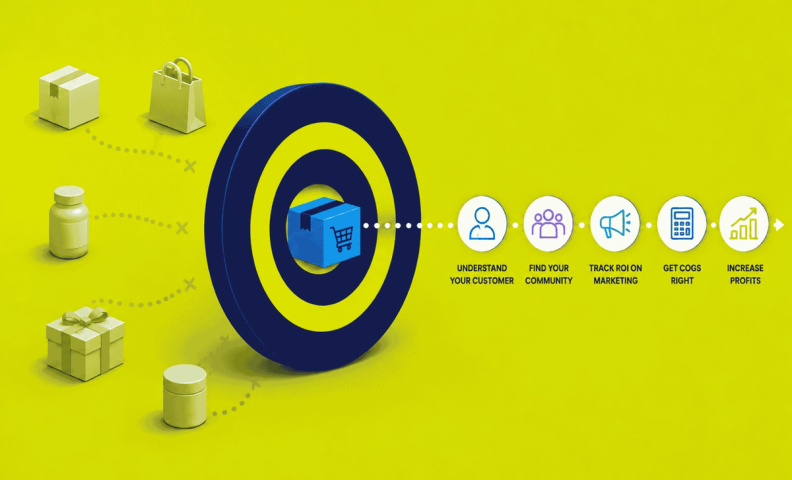
What's more important: profitability or growth? Both! Growth is important to long-term sustainability, but profitability allows a business to stay alive. Getting lost in one or the other can really hurt a business. Many young ecommerce businesses we have worked with get lost in focusing on growth, as it's exciting and easy to track. As we help them better track and focus on profit margins (both gross and net), in addition to growth, they experience healthy, sustainable growth. In addition, higher profits enable them to reinvest even more money into their growth strategies. This article focuses on ways to increase ecommerce profits that we have seen first-hand.
Going niche
A lot of ecommerce businesses lose their focus in pursuit of increasing revenue. They start branching into multiple products and markets that are unrelated. First, it can require big investments with unknown outcomes. Second, the overall brand strategy often does not align with all the products being sold. Finally, it becomes harder to understand, target, and relate to your core customer groups.
Therefore, we think it's quite important to at least start niche. Once you understand your customer segments, branching out may make sense. But give it time!
Understanding your customer
This is a fundamental rule that applies to all businesses, yet its relevance in ecommerce cannot be undermined. Many of the successful ecommerce businesses we have seen are started by a founder who IS their customer. That founder can easily connect with and reach the customer because they ARE the customer. This becomes crucial in optimizing results with marketing spend, which will increase ecommerce profits.
Also, if customers felt understood and loved, it creates a stickiness that is increasingly important in the cluttered ecommerce market space and profits. You need your customers loyal and coming back!
Finding a community
If you go niche, and cater to the understanding of your customer, you will likely find some sort of community. We see this over and over again. Finding a community unlocks a large source of “free” sales, leading to an increase in ecommerce profits. By “free” sales, we mean that people within that community will talk about your product and suggest it to others. Or, idols within that community will like and promote your product, often for free!
A great example of this is Traeger Grills. Traeger Grills understood their customer and broke into a close-knit community. Lots of people within the grilling and smoking community came to love Traeger. And that's when brand awareness and referrals spread like wildfire (or wild-smoke?) within this community.
Tracking ROI on digital spend
Every successful ecommerce business gets involved with digital marketing. However, the effectiveness of digital marketing efforts varies, and can be difficult to track.
- Where is organic traffic coming from?
- How much money are you spending on organic efforts?
- What's the conversion on organic traffic?
These are the questions you should be asking, not just for organic efforts, but for all your marketing initiatives.
Answering all these questions will lead you to a return-on-investment (ROI) for each marketing effort. If you can eventually track your ROI for all of your marketing efforts, you will find what is most effective. You can invest more in the efforts with a better ROI, leading to an increase in your profits.
If your marketing spend is creeping past healthy benchmarks without a clear payoff, our 8 Ecommerce Cost Cutting Strategies guide covers exactly how to audit and rein it back in.
Accurately account for cost of goods sold (COGS)
As ecommerce accounting experts, this is one area to increase ecommerce profits that we just can't skip. One of the most glaring ecommerce bookkeeping errors we continuously see with new clients is inaccurately calculating and recording COGS. As a result, ecommerce businesses don't know how to reduce COGS, and they are basing important business decisions off an inaccurate gross profit margin.
Gross profit margin (Sales – COGS/Sales), is also a VERY important number for ecommerce. Decisions on marketing efforts, new hires, growth strategies, etc. are often made by looking at gross profits. If you want the full picture of what counts as a healthy number here, our guide on what's a good gross margin for ecommerce lays out real benchmarks by business model.
Accurately calculating COGS can be complicated, but it's worth it. Get help if needed! By understanding all the costs that go into your COGS, you may be able to decrease costs. And don't forget to record COGS at the time of sale. It's amazing how many ecommerce businesses don't do this, which is crucial in getting an accurate gross profit margin.
Finally, make sure you are calculating and recording COGS by SKU. Comparing gross profit margins for various SKUs can help you purchase the right mix of SKUs to increase ecommerce profits. For more, here's an in-depth article on ecommerce COGS.
Frequently asked questions
Should ecommerce businesses focus on growth or profitability first?
Both matter, but they're not the same thing. Growth is exciting and easy to track, which is why many young ecommerce businesses over-index on it, but profitability is what actually keeps the business alive and funds further growth. Tracking gross and net profit margins alongside growth tends to produce healthier, more sustainable results than chasing revenue alone.
Why does going niche help increase ecommerce profits?
Spreading into unrelated products and markets requires large investments with uncertain payoff, and it makes it harder to understand and connect with any single core customer group. Starting niche lets you deeply understand one customer segment first; branching out can come later, once that foundation is solid.
How do I track ROI across different marketing channels, not just paid ads?
Ask the same questions of every channel, including organic: where is the traffic coming from, how much are you actually spending to generate it, and what's converting? Tracking ROI this broadly reveals which channels are genuinely worth investing more in, rather than only optimizing the ad spend that's easiest to measure.
Why does accurate COGS tracking matter for profitability?
Gross profit margin (Sales − COGS ÷ Sales) drives major decisions like marketing spend, hiring, and growth strategy. If COGS isn't recorded accurately, by SKU and at the time of sale rather than at purchase, that margin number is wrong, and every decision built on it is working from bad data.
When should an ecommerce business get professional accounting help?
Tracking profit tends to get manageable on its own in the early days, but as revenue approaches $1M, the numbers get complicated fast. That's usually the point where bringing in ecommerce accounting expertise pays for itself.
Let's turn these strategies into real profit
Every strategy in this article works better when it's backed by real numbers, especially COGS. As you approach $1M in annual revenue, tracking profit accurately gets a lot harder to do on your own. LedgerGurus can help you get accurate, SKU-level COGS and margin tracking in place, so the decisions you make about niching down, marketing spend, and growth are based on your actual numbers, not guesswork.
