

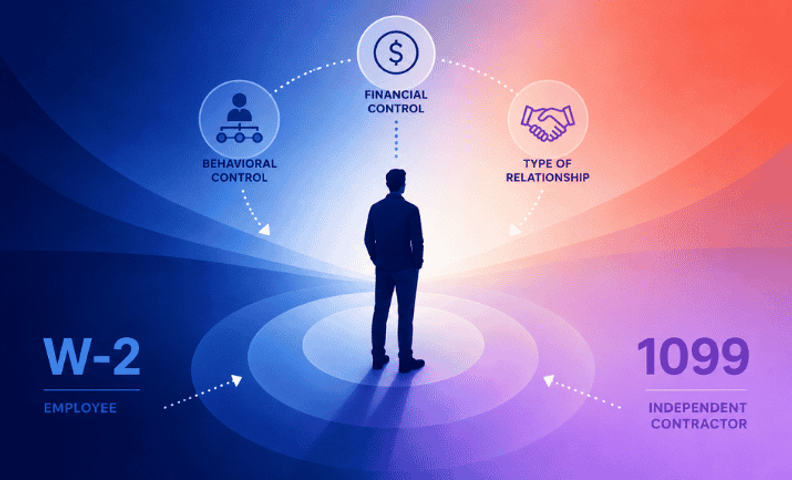
We are seeing states become more aggressive around the misclassification of W2 vs 1099 employees. As a small business owner, it's important to understand the IRS rules behind W2 vs 1099 employees and ensure that you are compliant.
You can also view our YouTube video, which has more details and examples on this subject.
One clarification before we dive in: This article covers the IRS's test for classifying workers, which determines how a worker is taxed. It's a separate framework from the Department of Labor's test under the Fair Labor Standards Act (FLSA), which determines eligibility for minimum wage, overtime, and other labor protections.
The DOL proposed a new version of its own test in February 2026, but as of this writing it's still a proposed rule, not yet in effect, so the current DOL framework remains what applies. If your question is about overtime or minimum wage eligibility rather than tax classification, that's the DOL's misclassification rulemaking page to watch, not this article.
IRS rules for classifying W2 vs 1099 employees
There can be significant fees and penalties for misclassifying employees. In addition, employees can sue their employer in some scenarios. So, let's dive into the important IRS rules for classifying W2 vs 1099 (also known as independent contractors) employees. There are 3 key rules that you should be aware of when analyzing if your employees are W2 vs 1099:
- Behavioral
- Financial control
- Type of relationship
Behavioral
This rule has to do with how much control the employer has with the worker's job and how the worker gets the job done. For a 1099 employee, the employer has less control over behavior. Are you telling the worker what tools to use, when to work, or how to do the work? If so, they are more likely to fall under the category of a W2 employee. If they are bringing their own tools/software and simply agreeing on requirements, they are more likely a 1099 employee.
There is a lot of gray area with the behavioral rules, but here are some key indicators to look for:
- Performance reviews: You can't have performance reviews for a 1099 employee. You can for a W2.
- Training: A 1099 employee brings and trains themselves for the most part, although an employer could help an independent contractor understand how the job needs to be done. A W2 employee is primarily trained by the employer.
All in all, the more detailed instructions you give a worker, they more likely they are to be a W2. If you are just agreeing on a set of requirements or end-project, and the worker gets the job done with their own tools, on their own time, they are more likely a 1099 employee.
Financial control
There are four areas of financial control to be aware of:
- Who invests in the employee? A 1099 employee invests in their own tools, software, training, etc. A business invests in these things for their W2 employees.
- Are business expenses reimbursed? A 1099 employee does not get reimbursed for business expenses from the employer. Whereas a W2 employee can be reimbursed from the employer for various business expenses.
- Can the employee lose money? A 1099 employee can actually lose money on a project or job. Since they are covering their own costs, they could spend more than they receive from the employer. On the other hand, a W2 employee will always get paid for the work they do, no matter how much that work costs the business.
- How is the employee paid? A 1099 employee dictates the payment terms. This includes the mode of payment and when they get paid. If the employer is dictating payment terms, the employee is a W2.
Type of relationship
The type of relationship an employer has with its employee helps determine a W2 vs 1099 employee. Here are a few things to look for:
- Contract terms: A 1099 employee usually has a contract with end dates. Whereas a W2 employee won't have end dates of employment written in the employee contract.
- Benefits: A 1099 employee does not get benefits from his or her employer. A W-2 employee does.
- Permanency of the relationship: A 1099 employee will generally have a less-permanent relationship with the employer. A W-2 employee has an indefinite relationship with the employer.
- Type of services provided: 1099 employees are often not doing work that is a core service of the employer's business. On the other hand, employees that are doing core competency work of the business are likely to be W-2 employees. For example, a law firm would need a good explanation as to why its lawyers are 1099 employees. A law firm hiring someone to do their marketing would more easily be able to explain them as a 1099 employee.
Pros and cons of W2 vs 1099 employees
Why hire a 1099 employee?
1099 employees have a lot of benefits for small businesses. With a 1099 employee, a business does NOT need to do provide or pay the following:
- Employer benefits
- Employer taxes
- Unemployment insurance
- Overtime wages
- Minimum wages
Why hire a W2 employee?
With all those benefits, there are still some reasons you would want to consider hiring an employee as a W2 vs 1099:
- A long-term commitment from the employee
- More control over their schedule and day-to-day work
- A W2 employee is usually more committed to your business
Consequences of misclassification
If you are found misclassifying W2 vs 1099 employees, you may face the following consequences:
- Being held liable to pay employment taxes
- The employee could sue you as an employer
- You may owe back benefits that they should have received
1099 reporting threshold increased for 2026
Separately from classification itself, the paperwork requirements around 1099 contractors changed this year too. The One Big Beautiful Bill Act raised the reporting threshold for Form 1099-NEC and Form 1099-MISC from $600 to $2,000, effective for payments made after December 31, 2025, the first adjustment to that threshold since it was set in 1954.
In practice, this means if you pay a contractor $1,800 over the course of 2026, you're no longer required to file a 1099-NEC for them. That doesn't change the contractor's obligation to report and pay tax on that income themselves. It only changes when you have to file the form.
Frequently asked questions
What's the main difference between a W2 employee and a 1099 contractor?
It comes down to control and investment. W2 employees have their tools, training, and schedule directed by the employer and receive benefits. 1099 contractors invest in their own tools and training, aren't reimbursed for expenses, and can even lose money on a project.
What are the three tests the IRS uses to classify workers?
Behavioral control (how much direction you give over how, when, and with what tools the work gets done), financial control (who invests in tools/training, whether expenses are reimbursed, and who sets payment terms), and type of relationship (contract terms, benefits, permanency, and whether the work is core to your business).
Can a 1099 contractor do the core work of my business?
It's risky. The IRS looks closely at whether the work is a core service of your business. A law firm hiring 1099 lawyers would be hard to justify, while hiring a 1099 marketer would be more defensible.
What happens if I misclassify an employee?
You could be held liable for unpaid employment taxes, owe back benefits the worker should have received, and face a potential lawsuit from the misclassified worker.
Why does worker classification matter more now than it used to?
States have become more aggressive about enforcing classification rules in recent years, so the financial and legal risk of getting it wrong has increased.
Did the 1099 reporting threshold change in 2026?
Yes. The One Big Beautiful Bill Act raised the threshold for filing Form 1099-NEC and Form 1099-MISC from $600 to $2,000, effective for payments made after December 31, 2025. This only affects your filing requirement, contractors still owe tax on all income regardless of whether a 1099 was issued.
Don’t let misclassification catch you off guard
Worker classification isn't just a legal risk, it also affects your payroll costs, your tax filings, and the accuracy of your books. LedgerGurus can help make sure your W2 and 1099 workers are set up and recorded correctly from day one, and our income tax services make sure that classification carries through cleanly at filing time.
