

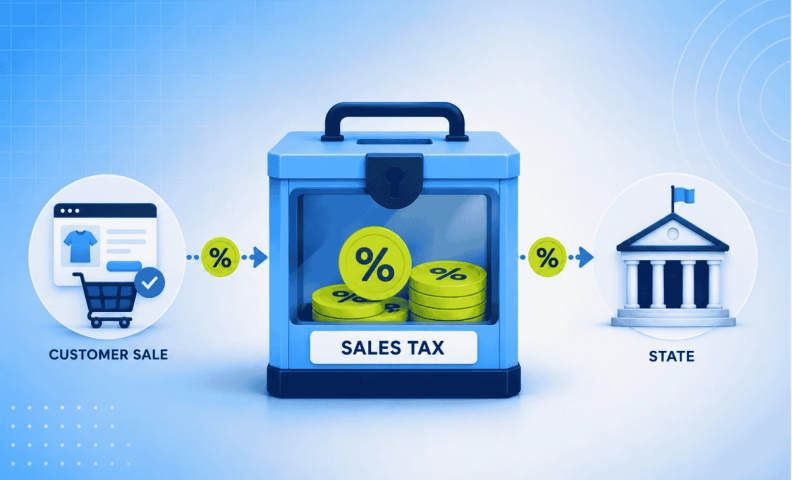
Let's talk about the least sexy part of running a business: sales tax. It's confusing. It's annoying. And worst of all? If you get it wrong, it can cost you big time. One of the biggest mistakes we see is when businesses record sales tax as income or expense, when it's actually neither. That money was never yours to begin with. You're just the middleman for the state, whether you like it or not.
In this blog, we'll break down what's really happening behind the scenes with sales tax in your accounting system. We'll show you how that money moves through your books, the journal entries that go with each stage, and how to avoid the cash flow chaos that happens when you treat tax money like a profit boost.
The most common sales tax mistake businesses make
The most common mistake we see businesses make is to record sales tax as income when they collect it (either individually as sales tax income, or grouped into the money they collected on the sale), and then as sales tax expense when it's paid out.
Keep in mind that sales tax is neither income nor an expense to your business. You are collecting sales tax on behalf of someone else, the state. When you collect sales tax, you are now holding money that doesn't belong to you, which is why you should record it as a liability when you collect it. When you send it on to the state you are relieving yourself of the liability on your books. You should never see sales tax on an income statement! Sales tax should always be shown as a liability on the balance sheet, increasing and decreasing as you collect and remit.
To show you what this should look like, as well as to see other common mistakes we often see ecommerce businesses make, download our 5 Ecommerce Bookkeeping Warning Signs.
The stages of accounting in sales tax
There are different phases along the sales collection and remittance path. You want to be sure you're recording them properly so you know you've remitted everything you've collected.
Stage 1: Sales tax collection, and the associated journal entry
When you collect sales tax from a customer, you now have a liability to the state for those collected funds. The journal entry for the collection of sales tax looks like this:
| Debit | Credit | Account | |
|---|---|---|---|
| Cash | $XXX | Asset | |
| Sales Tax Liability | $XXX | Liability |
We recommend a couple of things with this journal entry:
- Record a sales tax liability for each state
- Make this journal entry at month-end by referring to sales tax reports from your POS systems and online sales channels
Stage 2: Waiting to remit sales tax to the states
You will have sales tax funds sitting in your business between the collection of sales tax funds from customers, and the remittance of sales tax funds to the states. This stage is important to note, because some companies forget about their sales tax liabilities.
They see cash sitting in their bank account and use that cash to grow their business. Then when sales tax funds are due to the states, they come to find that they don't have the cash to pay, yeah, not the situation you want to be in. If that's already happened to you, our guide on catching up on past due sales tax walks through your options. To avoid this scenario, we recommend keeping collected sales tax funds in a separate bank account. Then, you'll use the funds from this account to remit taxes to the states.
Stage 3: Sales tax remittance, and the associated journal entry
You will owe sales tax monthly, quarterly, or annually. The frequency depends on each state and the amount of sales tax you owe. When you pay your sales tax liabilities (using the funds set aside in a bank account used solely for sales tax funds), here is the associated journal entry:
| Debit | Credit | Account | |
|---|---|---|---|
| Cash | $XXX | Asset | |
| Sales Tax Liability | $XXX | Liability |
Sales tax compliance is more than just journal entries
Recording these journal entries correctly is just one step in the process of sales tax compliance.
Additional steps include:
- Understanding in what states you owe sales tax (this is nexus)
- Setting up your POS systems and sales channels to collect sales tax.
If you are an ecommerce company, you face an even more complex step-by-step process for sales tax compliance that can destroy some businesses when executed poorly. Not sure where your compliance actually stands? Take our free Sales Tax Risk Assessment, 20 quick questions, about five minutes, for a personalized read.
Frequently asked questions
Why shouldn't I record sales tax as income when I collect it?
Because it was never your money to begin with, you're just holding it on behalf of the state until you remit it. Recording it as income overstates your revenue and can create real confusion about your actual profitability.
What's the journal entry when I collect sales tax from a customer?
Debit Cash for the total amount collected, and credit Sales Tax Liability for the sales tax portion. The sales tax never touches your income statement, it goes straight to a liability account on your balance sheet.
What's the journal entry when I remit sales tax to the state?
Debit Sales Tax Liability and credit Cash, both for the amount you're paying. This relieves the liability on your books since you no longer owe that money to the state.
Why should I keep collected sales tax in a separate bank account?
Because it's easy to spend cash sitting in your main account without realizing a chunk of it isn't actually yours. Keeping sales tax funds separate protects you from coming up short when it's time to remit.
How often do I need to remit sales tax?
It depends on the state and how much sales tax you collect there, monthly, quarterly, or annually. Each state sets its own filing frequency based on your sales volume.
Is recording accurate journal entries enough to be sales tax compliant?
No. You also need to know exactly where you have nexus and owe tax, and make sure your sales channels and POS systems are actually set up to collect the right amount in the first place.
Get your sales tax journal entries (and everything else) right
If managing sales tax feels overwhelming, we can take it off your plate entirely, from accurate journal entries to full compliance across every state you sell into.
