

Navigating sales tax is one of the top reasons our clients reach out to us for help. Where you do business, what you sell, who your customers are, and when you owe tax all affect your liability as an online seller, and understanding whether you qualify for exemptions is a key part of that picture.
Today we're breaking down a critical piece of managing sales tax: your exemptions. It takes real time and research to map out your full exemption picture, since it's different for every business, but getting the right paperwork in place is worth the tax savings.
(Check out our accompanying video: Do You Qualify For a Sales Tax Exemption?)
What are the types of sales tax exemptions?
First off, let's get clear about the basics. Sales tax exemptions apply both on the selling side of business and the buying side. On the selling side, it means you do not have to charge sales taxes to your customers. On the buying side, it means you do not have to pay sales taxes for your business purchases.
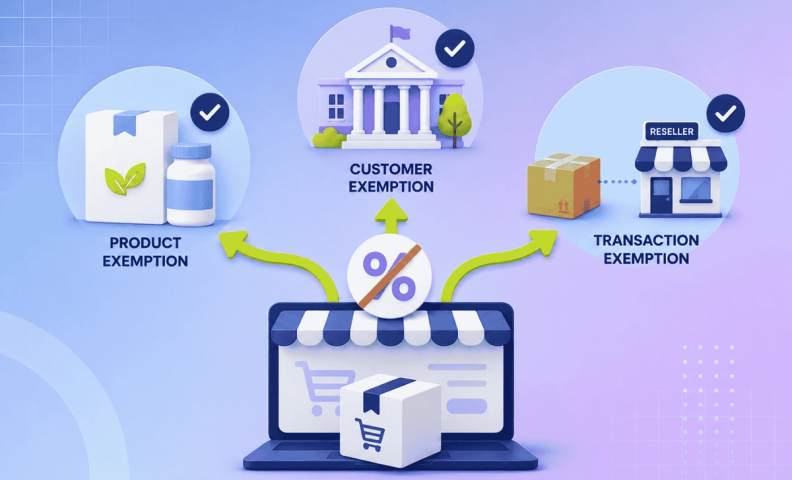
For the selling side, there are three types of sales tax exemptions:
- Product exemption: This applies when a specific product (e.g., food, clothing, supplements) is not taxable. Product exemptions vary by state, and as an online seller, you do not have to maintain documentation where they apply because the exemption is already covered in legislation. (For online sellers using Shopify to handle your transactions, you can easily create a list, or collection, of these products and mark them with 0% tax to automatically address the sales tax exemption. For step-by-step instructions, check out our blog: Shopify Sales Tax Setup.)
- Customer exemption: This applies when the type of customer is exempt from paying sales taxes. Often, these are government entities, schools, or non-profits organizations. In this scenario, the customer has to provide a valid exemption certificate of their status, and you, as the seller, must maintain documentation on file.
- Transaction exemption: This applies if you are selling a product to a distributor who will then resell the product. In this scenario, the sales tax responsibility falls on the distributor and not on you, and to have tax exempt status, you will need to obtain a resale certificate from them.
For the buying side of a transaction, if you are purchasing inventory from a wholesaler or manufacturer directly and they are dropshipping the product to the customer, you shouldn't be charged sales tax. This is because you will be collecting sales tax from your customers where you have nexus; thus, the relationship between you and the dropshipper should be tax-free. This is the scenario where YOU will need to provide an exemption certificate to your supplier.
Certificates for sales tax exemptions
As an online seller, you are responsible for knowing your tax liability and making sure you maintain proper documentation for the sales tax exemptions listed in the scenarios above. In this, you have to make sure you have the right forms for the respective state. Make sure that they contain all necessary information, the tax ID numbers are valid, and signatures are in place.
Unfortunately, there is not a universal exemption certificate (form) for the entire U.S. If your supplier is located in your same state, you can download a resale certificate from your state's website. If, however, your supplier is located in a different state, you will need to find out what documentation is required. For most states, they will accept either the Multistate Tax Commission (MTC) Resale Certificate or the Streamlined Sales Tax Agreement (Certificate of Exemption) with your tax ID number.
If your supplier is located in a state that does not accept one of these two forms, you will need to obtain the state-specific form, and possibly even a separate tax ID number in that state. If this latter scenario applies to you, we encourage you to reach out to us for a consultation so we can pinpoint the specific documentation you need and make sure you are covered!
Getting on track
Now that we've covered the basics, it's worth doing a full review of your sales tax exemptions and getting the necessary documentation in place if you haven't already. It's not the most exciting task, but it directly reduces your tax liability and audit risk, missing or invalid certificates are exactly what sales tax audits look for.
To help, we've created a Sales Tax Compliance Checklist covering the big topics you need to plan for: determining sales tax nexus, collecting and recording sales tax, filing and paying, and keeping up with changes. For the full range of what else can trip up your compliance, see our guide to 9 sales tax compliance challenges, and if nexus itself is still fuzzy, start with our complete guide to sales tax nexus.
Frequently asked questions
What's the difference between a product exemption and a customer exemption?
A product exemption applies to specific items (like food or clothing) that are non-taxable under state law, no documentation required. A customer exemption applies to certain buyers (governments, schools, nonprofits) who must provide a valid exemption certificate that you keep on file.
Do I need to keep documentation for product exemptions?
No. Product exemptions are already written into state law, so as an online seller you don't need to maintain certificates for them, unlike customer and transaction exemptions.
Who provides the exemption certificate in a dropshipping relationship?
You do. If you're buying inventory from a dropshipping supplier, you're the one who needs to provide the exemption certificate to them, since you'll be the one collecting sales tax from your end customer instead.
Is there one universal exemption certificate I can use in every state?
No. Most states accept either the Multistate Tax Commission (MTC) or the Streamlined Sales Tax (SST) Certificate of Exemption, but some states require their own specific form, and possibly a separate tax ID in that state.
What happens if my exemption certificates aren't valid or complete?
You become liable for the uncollected sales tax if you're audited. Make sure certificates have all required information, valid tax ID numbers, and proper signatures before relying on them.
How do I know which exemption certificate to use for an out-of-state supplier?
Check whether that state accepts the MTC or SST forms first, most do. If it doesn't accept either, you'll need to get that state's specific form, and potentially register for a tax ID there as well.
Getting your exemptions documented right
Reviewing your sales tax exemptions and getting the right documentation in place now saves you from a much bigger headache later, especially if you're ever audited.
Not sure where your exposure stands? Take our free Sales Tax Risk Assessment, 20 quick questions, about five minutes, for a personalized read.
For the full picture, download our Sales Tax Compliance Checklist, or if you'd rather have an expert handle it, reach out to our sales tax team.
