


Your business is growing, but your inventory tracking hasn't kept up. You're ready to invest in an inventory management system, but you also know a botched implementation can cost more time and money than sticking with your current mess. That's a fair concern. IMS implementations fail often enough that it's worth getting right the first time, and the difference between a smooth rollout and a costly one almost always comes down to preparation.
Why bother with inventory management?
Inventory management isn't just about shuffling goods around, it's what keeps your ecommerce operations running smoothly. But implementing the right inventory management system for your specific needs is what actually determines whether that happens. Here are the 10 mistakes we see most often, and how to avoid each one.
If you aren’t ready for implementation yet, read Your Inventory Management Roadmap It’s a constructive roadmap of how to manage your inventory effectively.
10 inventory management mistakes to avoid during IMS implementation
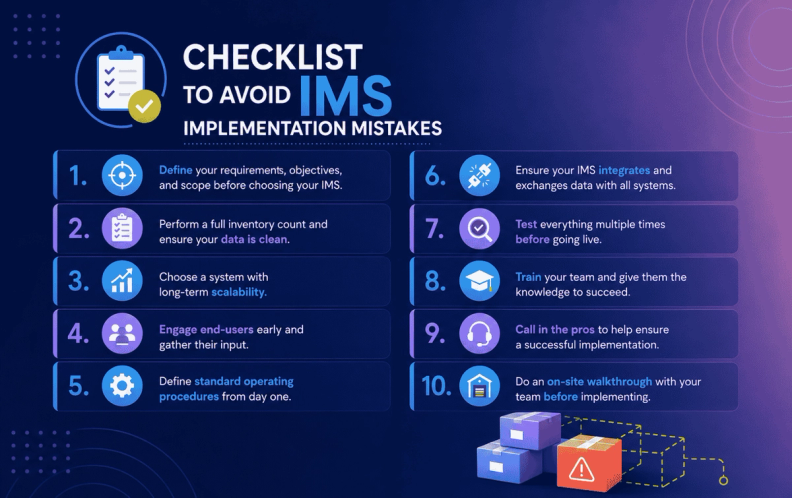
1. Insufficient research and planning
“If you fail to plan, you plan to fail.” - Benjamin Franklin
Benjamin Franklin's advice applies directly here: choosing an IMS without thinking through how it'll fit your daily operations sets you up for inefficiency, confusion, and delays down the line. Here's a real-world example: say you run an ecommerce store selling handcrafted candles, and you're considering an IMS to track your inventory. Before you commit, ask:
- Will it track different scents, sizes, and materials efficiently?
- Will it integrate with your order processing system?
- Will it help you get orders out on time?
Without that groundwork, you can end up with a system that's expensive, inaccurate, and doesn't actually help. It's also worth resisting the pull toward a tool with more features than you need, extra complexity you're not using just makes implementation harder. Look for a solution built for your specific workflows and requirements.
Take the time to define your requirements, objectives, and the scope you want the tool to cover before you start. You're investing real time, effort, and money in this, so it's worth doing the planning work first. Learn how to choose the right IMS for your business.
2. Poor data quality
"Garbage in, garbage out" applies just as much to inventory systems as it does to code. Implementing a new IMS on top of inaccurate or incomplete data will only get you incorrect inventory counts, ordering mishaps, and a range of other problems. Perform a full inventory count just before you go live, and make sure your data is clean before it goes into the new system. Here's what that cleanup should include:
- Clean the data up: Remove duplicate records, correct inaccurate entries, and eliminate inconsistencies.
- Validate the data: Confirm it follows the rules it needs to, quantities are numerical and positive, product codes follow the correct format, and so on.
- Standardize the data: Format everything uniformly, units, dates, and formats should be consistent.
- Transform the data to fit: Adjust fields and attributes to match the new system's structure.
- Make sure the data is relevant: Remove outdated, irrelevant, or redundant records.
- Enrich the data: Add useful information where you can, better descriptions, images, or other attributes the new system can use.
3. Neglecting scalability
Your business isn't standing still, and an IMS that can't grow with it will become a liability. If your chosen tool can't handle your expanding inventory needs, you'll eventually be stuck choosing between an undersized system and a costly migration to a new one. When choosing an IMS, think long-term. Pick a tool that can scale as your business grows, scalability isn't a nice-to-have, it's what keeps your inventory system useful two or three years from now instead of something you have to replace. Read more with Why Inventory Optimization is Critical.
4. Failure to involve key stakeholders
Leaving out the people who'll actually use the system day in and day out is one of the most common ways implementations go sideways. Without input from end-users, you risk ending up with a tool that doesn't fit how your team actually works. Involve stakeholders from different departments early, not after the decision is made. Their insight helps ensure the tool is genuinely user-friendly and fits real workflows, not just what looked good in a demo. Engage end-users, listen to their needs, and gather input from multiple perspectives before you commit.
5. Not establishing clear processes
Introducing a new IMS without defining clear inventory management processes leads to inconsistent data entry, mismatched interpretations of how tasks should be done, and avoidable chaos. Define standard operating procedures for your IMS, clear guidelines for how the tool should be used, from data entry to order fulfillment, give your team a consistent way to work instead of leaving it up to individual interpretation.
6. Ignoring integration
If your IMS, accounting software, and sales platform don't talk to each other, your data ends up siloed. That means duplicated work, wasted time, and decisions made on incomplete information. When implementing an IMS, make sure it integrates cleanly with your existing tools. Don't skip this step: your systems need to exchange data automatically to eliminate duplication and keep everything in sync. Integration isn't optional. It's core to whether the system actually improves your operations.
7. Lack of thorough testing
Inadequate testing during implementation leads to bugs, disruptions, and problems you'll be fixing after go-live instead of before. Test your IMS thoroughly before rolling it out. Run it through different real-world scenarios, confirm every function and integration point works as expected. Don't just test the IMS on its own, test data flow between systems, from sales to accounting, to confirm everything syncs correctly before you depend on it.
8. Insufficient staff training
A new tool that's supposed to make your team's job easier will do the opposite if they don't know how to use it. Frustration builds, mistakes multiply, and productivity drops. The fix is straightforward: provide real training so your team actually understands the system. If your team is as new to the tool as you are, working with an experienced implementation partner solves two problems at once, they can implement the tool and train your team on how to use it.
9. Inadequate expertise for self-implementation
Attempting to implement a new inventory platform without the right expertise in-house often leads to confusion, mistakes, and delays that could have been avoided. An experienced implementation team can assess your business needs, customize the tool accordingly, and guide the rollout in a way that avoids the common pitfalls of self-implementation.
10. Missing an on-site walkthrough before implementation
Even with everything else planned well, skipping a walkthrough with your implementer means important operational details can get missed. An on-site walkthrough with a representative from the IMS or your implementation team before implementation begins prevents this. It lets your implementation team see your actual warehouse operations firsthand, understand your workflow, and identify the specific challenges your business faces, details that are easy to miss from a written description alone.
Benefits of proper inventory management software implementation
Getting implementation right pays off in concrete ways:
- Streamlined operational workflows: Inventory processes that integrate cleanly into how your business already runs.
- Accurate inventory data for informed decision-making: Decisions backed by real numbers instead of guesswork.
- Scalability to meet growing demands: A system that adapts as your order volume and SKU count grow, instead of one you outgrow in a year.
- Efficient, error-reduced processes: Fewer manual mistakes and less time spent tracking down discrepancies.
- Improved staff productivity and morale: A tool your team can actually use well, instead of fighting against.
- Seamless integration with other systems: Inventory data that flows automatically into accounting and sales platforms.
- Enhanced customer satisfaction from accurate stock availability: Fewer stockouts, fewer disappointed customers, fewer lost sales.
- Data-driven insights for strategic planning: Real inventory data informing growth decisions instead of gut feel.
For more detail, read The Top 10 Benefits of an Inventory Management Software.
IMS tools we use & recommend
There are several tools we're very familiar with and can help you get started on. Each has different strengths, and we can help you choose the one that's the right fit for your business.
The tools we recommend most:
For more information, read 5 Tips on Choosing the Best Inventory Management Software for Your Ecommerce Business.
Frequently asked questions
What's the most common mistake businesses make when implementing an inventory management system?
Skipping strategic planning, choosing a tool before clearly defining your requirements, objectives, and workflows. Without that groundwork, you often end up with a system that's expensive, inaccurate, and doesn't actually fit how your business operates.
Why does data quality matter so much before switching to a new IMS?
Migrating messy or inaccurate data into a new system just carries the same problems forward, incorrect inventory counts, ordering mishaps, and more. A full inventory count and real data cleanup before go-live is essential.
Do I need to involve my whole team in choosing an inventory management system?
Yes, at least the people who'll actually use it day to day. Skipping input from end-users often results in a tool that doesn't fit their actual workflow, which hurts adoption no matter how good the software is on paper.
Should I implement an inventory management system myself, or hire help?
Unless your team already has real IMS implementation experience, working with an experienced partner significantly reduces the risk of costly mistakes, they can customize the tool to your business and train your team at the same time.
Which inventory management tools does LedgerGurus recommend?
Finale Inventory and Katana are two we're very familiar with and implement often, though the right choice depends on your specific business needs.
Get your IMS implementation done right the first time
Avoiding these 10 mistakes is a lot to manage on top of running your actual business. LedgerGurus can also help with your inventory and COGS accounting once your new system is live, so you're making decisions based on solid, reliable numbers, not guesswork.
