

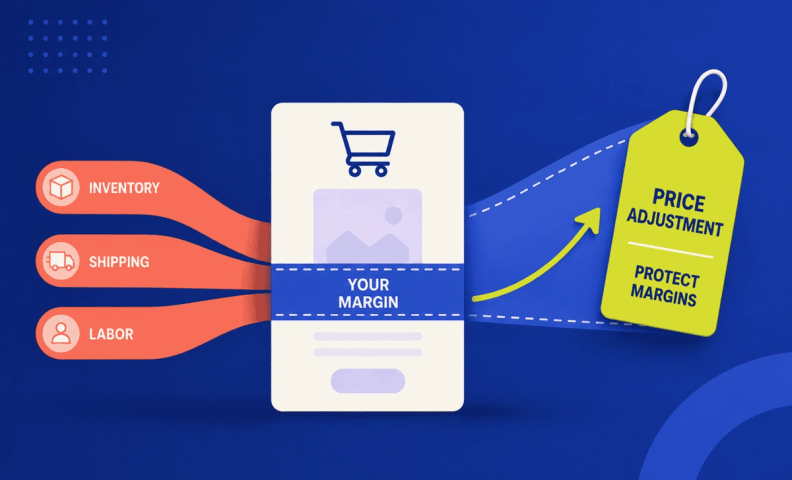
Has your business raised prices lately? Even if you have, it's worth continually evaluating your pricing and costs. Inflation isn't a one-time event. It's a cycle that shows up periodically, and it can quietly eat away at your margins if you're not paying attention.
Why you should consider raising prices
Inflation runs in cycles. It can stay low for years, then pick up sharply in response to supply shocks, spending surges, or shifts in monetary policy. Whether a given inflationary period turns out to be short-lived or long-lasting, it shouldn't be ignored. Let's look at how it typically happens.
How do we get inflation?
Without being a wonky economist, inflation usually comes down to a few recurring drivers:
- Supply and demand: Supply chain disruptions (from natural disasters, geopolitical events, or shifts in manufacturing capacity) paired with a sudden jump in consumer demand can outpace what suppliers can produce, pushing prices up.
- Government spending: Large-scale government stimulus or spending injects money into the economy. That can help stabilize things in the short term, but too much spending relative to output tends to overheat the economy and drive prices higher.
- Consumer savings: When consumers build up savings, whether from a slowdown in spending, wage growth, or other factors, pent-up demand can flood the market once confidence returns, pushing prices up further.
These factors add up to lots of spending on chasing limited supply, and that's what shows up as rising prices.
Inflation Examples
We see price increases in almost every category, including:
- Commodities
- Cars
- Core Inflation
- Homes
- Gas
- Wages
Bottom line: higher prices show up broadly, and that affects every business.
How inflation might be impacting your business
I'm going to speak to issues for product-based ecommerce companies specifically, but these examples apply broadly.
- Inventory: Commodities go up, and those raw materials go into your products. Is your purchase price of inventory higher than it was a year or two ago?
- Shipping and fulfillment: Fuel costs and labor availability both affect this. Are your costs up compared to previous periods?
- Labor: Are you paying more to hire or retain your employees?
These costs can sneak up on a business, so it's time to start looking at them closely.
The danger of not increasing prices
Even a short-term spike in costs can affect your cash flow and bottom line. Let's say you have 10% net income with 40% cost of goods sold (COGS) as a share of revenue. Now let's say your COGS increases by 10% due to increased input costs and shipping. Your COGS is now 44% and net income is 6%. On a $100,000 revenue-per-month business, that is a decrease from $10,000 in net income to $6,000. What were you doing with that extra $4,000 a month? Should inflation continue, you could quickly see your margins erode to no profit at all.
Next steps
If that got your attention, there are two key steps to take:
- Analyze your costs to determine inflation's impact
- Determine how to adjust prices in response
Analyze your business costs to determine the impact of inflation
Prices are going up all around us, but how do you know if it is impacting your business?
Your financials will have the answers... eventually
Will your Profit and Loss (P&L) tell you if you are experiencing inflation? Yes, but it may take some time, and by the time it does, it may be too late.
Here's what to look at:
- Gross margin: Is it decreasing over time? Make sure you're comparing similar periods, and exclude any anomalous periods (like a temporary demand spike or supply shock) that would skew the comparison.
- Shipping and fulfillment as a share of income: This ratio (expense divided by revenue) lets you compare costs across time periods. If the ratio is climbing, those costs are increasing relative to your revenue.
- Labor as a share of income: Payroll costs are often split across multiple accounts on your P&L, but this ratio can reveal whether your labor share is creeping up.
For more information on analyzing your P&L, watch this video. Before you dive in, here are some challenges with this approach.
Why your P&L might not be enough
Going off the P&L alone depends on good accounting, and it can take time for the answers to emerge. Here's why:
- Timing: Ideally, costs and revenue are tied to the same time period. This is a common mistake we correct for many new customers. An income ratio only works when the costs align with the revenue for that period.
- COGS and inventory: COGS is not your inventory expense. This is one of the most common errors we see with product businesses. The correct way to account for inventory is to record it on the balance sheet as an asset, then decrease that amount and recognize it as COGS as the inventory is sold. The catch: COGS today reflects inventory purchases from a previous period, sometimes a month ago, sometimes six months ago, depending on your inventory turns.
- Labor costs are diluted: Labor's share of costs can creep up slowly. A new hire might cost 10% more than the previous person, but that cost gets diluted across your total labor spend. It takes time for the impact to really show.
Bottom line: You can use your P&L to identify inflation, but it can take months or quarters to see the impact. Let's explore some other ways to analyze your costs for inflation.
Inventory and inflation
The best way to analyze inventory costs is to compare purchase costs now versus before. Use an inventory tool, a product cost catalog, or anything that shows the cost of a given SKU now versus in the past. It's simple math: SKU 123456 cost $10 before and now costs $11, a 10% increase. The challenge comes when you have a lot of SKUs, but good records make this manageable.
You can analyze each SKU individually and average the differences, though a weighted average (accounting for purchase quantity per SKU) gives you a more accurate read on overall cost changes.
Shipping/fulfillment and inflation
Analyzing shipping and fulfillment can be a bit easier than inventory. Normalize your costs to compare across time periods, either with an income ratio or a metric like dollars per unit shipped. Just make sure you're comparing apples to apples, since not every unit costs the same to ship.
Labor and inflation
Assessing labor costs is more challenging due to the dilution effect mentioned earlier. Typically, new hires cost more, then existing employees start asking for (or leaving for) better pay, and it adds up over time.
Three things to consider:
- Labor income ratio: Not perfect, but the trend over time can be telling.
- New hire costs: How much are you paying for the same role now versus before? One hire doesn't show a trend, but a pattern of jumps across multiple hires does.
- Market data: Slow-moving, but keep an eye on wage trends in your specific industry and role types, since they vary widely by occupation.
Trends are better than perfection
Getting a precise read on cost increases takes time. Is it better to know your costs are up 5.7%, or that they're up somewhere between 4-8%? Precision helps, but the amount you actually need depends on the pricing decision at hand. A good range can be enough to act on.
Analysis done. Now what? Once you've done the analysis and confirmed costs have gone up, it's time for the harder decision: if and how much to raise prices.
Adjusting prices to respond to inflation
For this example, let's assume your costs are up 5% over the past year. Now let's take action.
To increase or not to increase prices
The first question: Do you raise prices? Some businesses hold prices steady to protect customer loyalty or sales volume, hoping costs come back down. Just know that rising costs directly affect profitability. Too many business owners focus on revenue instead of profitability. Don't fall into that trap.
Price increases might feel uncomfortable, especially after a stretch of low inflation, but they're a normal and recurring part of running a business. Subscription services, retailers, and manufacturers all raise prices periodically as their own costs shift.
If you're ready to raise prices, read on. If not, watch your margins closely.
How to price
Pricing is a dark art. There is no single path to pricing perfection, but there are a number of methods. Here are a few:
- Cost adjusted
- Market based
- Elasticity based
Pricing can get very complex. What follows is a simplified version that might make an economist wince, but it's still valid and useful.
Cost-adjusted pricing
Cost-adjusted pricing means marking up your prices to offset your cost increase. If your inflation analysis shows costs up 5%, you raise prices 5% to maintain margins. It's a bit old school, but it works.
Market-based pricing
This approach compares your pricing to competitors' and lets you decide to price the same, higher, or lower. It can get tricky:
- You need to compare similar products, easy for resellers, harder for direct-to-consumer brands with unique products.
- Rapidly changing environments create instability. If Company A raises prices and Company B hasn't yet, is that still an accurate comparison?
- Alternatives complicate the picture. A price comparison can look very different depending on what customers see as the substitute product or service.
Issues aside, it's worth keeping an eye on competitor pricing as you make decisions.
Elasticity-based pricing
Elasticity is a bit more complex. Here’s the technical definition:
A good's price elasticity of demand is a measure of how sensitive the quantity demanded of it is to its price. When the price rises, quantity demanded falls for almost any good, but it falls more for some than for others. The price elasticity gives the percentage change in quantity demanded when there is a one percent increase in price, holding everything else constant.
Another way to think about it: imagine 100 potential customers. Different prices determine how many of them are willing to buy. The cheaper the price, the higher the quantity sold. The higher the price, the better the profit per unit. Ideally, you optimize for overall profit, which usually sits somewhere in the middle.
There are tools and analysts who specialize in elasticity analysis if you want to go deeper here. Just note that elasticity shifts as markets change. A price that feels high today may not in a year. In a fluid market, elasticity should be measured regularly.
Making a decision
Cost-adjusted, market-based, and elasticity-based pricing are just three methods. Sometimes the best approach combines more than one. Markets aren't always elastic, competitor pricing isn't always a reliable benchmark, and cost-based pricing, while safe, can leave money on the table.
Here's a recommendation:
- Analyze using one or more methods
- Make a decision
- Measure the results, paying attention to margins more than revenue
Pricing is a pain, but it's one all businesses should revisit regularly, and more frequently during inflationary periods. If you're not careful, inflation will steadily eat into your profitability.
Frequently asked questions
How can I tell if inflation is actually affecting my business?
Look at three cost areas: inventory (are per-unit costs up vs. last year), shipping and fulfillment (as a share of revenue), and labor (are you paying more to hire or retain people). Your P&L will eventually show it, but by the time it does, margins may already be shrinking.
Why doesn't my P&L show inflation right away?
Because COGS today reflects inventory you purchased in a prior period, sometimes months earlier, and labor cost increases get diluted across your whole payroll. Both effects delay when inflation actually shows up in your numbers.
What's the difference between cost-adjusted, market-based, and elasticity-based pricing?
Cost-adjusted pricing marks up prices to match your cost increase (raise prices 5% if costs rose 5%). Market-based pricing sets prices relative to competitors. Elasticity-based pricing sets prices based on how sensitive customer demand is to price changes. Most businesses benefit from combining more than one approach.
Is it risky to raise prices during inflation?
Holding prices steady to protect customer loyalty can feel safer, but it directly erodes your margins. Even a 10% cost increase can cut your net income nearly in half if you don't adjust prices to match.
How often should I revisit my pricing?
Regularly, and more frequently during inflationary periods. Analyze your costs, make a pricing decision, then measure the results with an eye on margins rather than just revenue.
Stop letting inflation quietly eat your margins
Spotting inflation in your numbers, and knowing exactly how much to raise prices, isn't something you want to guess at. It takes clean books and a clear read on your real costs by SKU, channel, and time period.
LedgerGurus specializes in ecommerce accounting, and we help clients see exactly where inflation is hitting their margins, and what pricing move actually protects profitability.
