

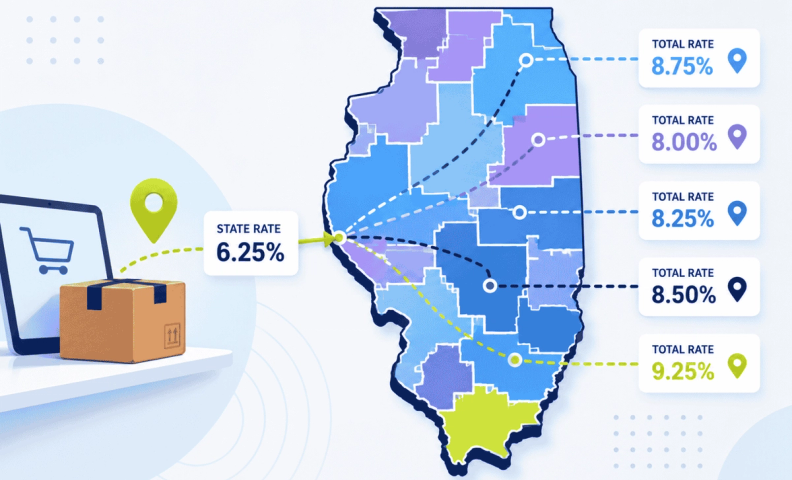
If you're a remote seller shipping into Illinois, two things determine what you need to do: whether you owe destination-based Retailers' Occupation Tax (ROT) instead of the old flat Use Tax, and whether you've actually crossed the state's economic nexus threshold in the first place. Illinois first required remote sellers without a physical presence in the state to collect ROT, instead of just the flat 6.25% Use Tax, starting January 1, 2021, to level the playing field with in-state sellers, who'd always collected both the state and local rates. As of January 1, 2026, Illinois simplified the nexus test further: the 200-transaction threshold is gone, and $100,000 in cumulative gross receipts is now the only number that matters.
By the way, having inventory in an FBA warehouse does not count as having a physical presence in Illinois, so FBA sellers are generally evaluated under these remote seller rules too, unless a marketplace facilitator is already handling collection on their behalf.
What rates should you be collecting as a remote seller vs. an in-state seller?
Previously, remote sellers simply collected 6.25% sales tax and filed a Use Tax return. That is now changing as remote sellers are now required to pay the local tax rates, as well. If you fit the criteria, you must switch over to collecting Retailers' Occupational Tax. This is a destination-based tax and is collected at both the state & local levels.
Do you meet Illinois's economic nexus threshold?
None of the rest of this guide applies to you unless you cross Illinois's economic nexus threshold first.
As of January 1, 2026, that threshold is $100,000 in cumulative gross receipts from sales of tangible personal property to Illinois customers, measured over a 12-month lookback period. The 200-transaction threshold that used to apply alongside it has been removed entirely, transaction count no longer matters, only the dollar amount does. If you're under $100,000, you have no ROT obligation as a remote seller (though you can voluntarily collect and remit 6.25% Use Tax if you'd like to). If you're over it, keep reading.
Do you even need to file this yourself?
If you sell exclusively through a marketplace like Amazon, Walmart, or Etsy, check this before worrying about ST-1 and ST-2 at all. Marketplace facilitators that meet Illinois's own collection threshold are required to collect and remit ROT on behalf of their sellers. If that's true for your marketplace (Amazon, for example, meets it), those sales are handled for you, you don't report them on your own Form ST-1, and you don't need a separate ROT account just for marketplace sales.
You're still responsible for filing and collecting on any sales made outside the marketplace, like through your own Shopify store. If you sell on both, only your non-marketplace sales go on your ST-1 and ST-2.
What do you need to do to comply with Illinois sales tax?
In order to comply with sales tax in Illinois, you'll need to:
- Switch your account from a Use Tax acct to a Retailer's Occupational Tax acct.
- Fill out an ST-1 form AND an ST-2 form when you file.
How to fill out the Illinois sales tax forms ST-1 & ST-2
If you've crossed the $100,000 threshold and you're not fully covered by a marketplace facilitator, you'll file two forms together: Form ST-1 (Sales and Use Tax and E911 Surcharge Return) and Form ST-2 (Multiple Site Form). Both are filed electronically through MyTax Illinois.
Why two forms instead of one: Illinois's ROT is destination-based, meaning the tax rate depends on where each customer is located, not a single statewide rate. Form ST-2 is where that breakdown happens.
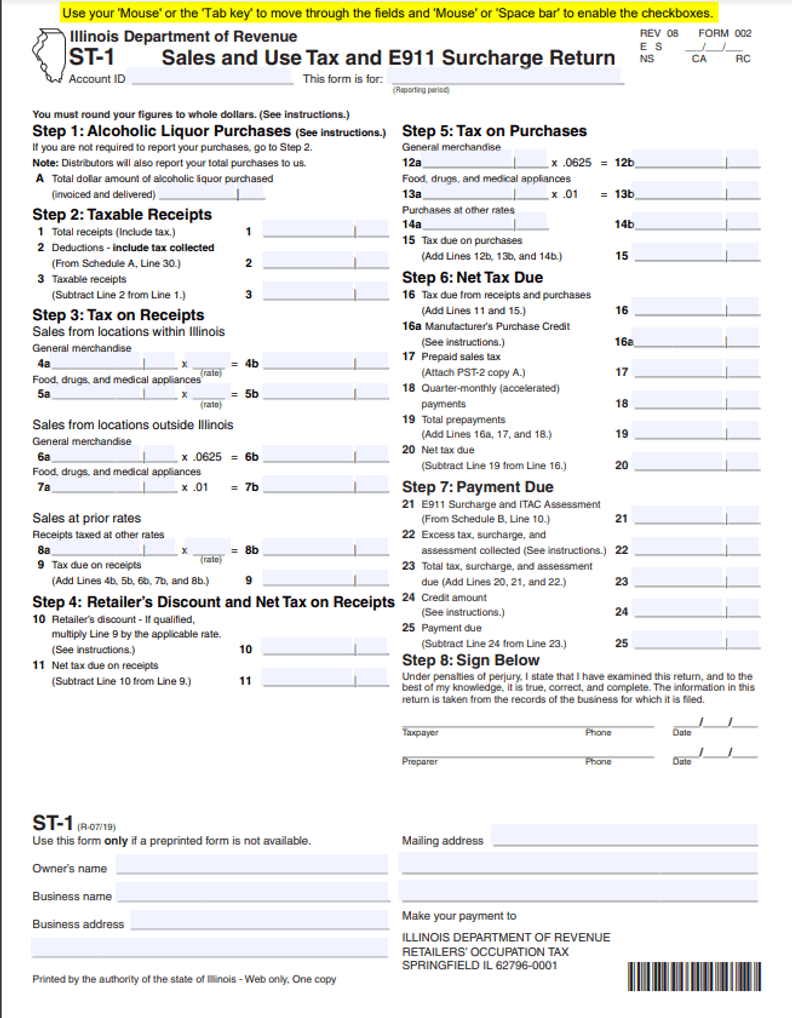
Here's how the two forms work together:
- Form ST-2 captures the detail. For every local jurisdiction (city or county) where you made a destination-based sale, you report the sales total and the specific local rate that applied. Illinois separates these by jurisdiction, not by individual customer, so you're grouping sales by location, not listing every transaction one by one.
- Form ST-1 pulls in the totals. The jurisdiction-by-jurisdiction figures from ST-2 feed directly into the corresponding lines on ST-1, which calculates your total tax due.
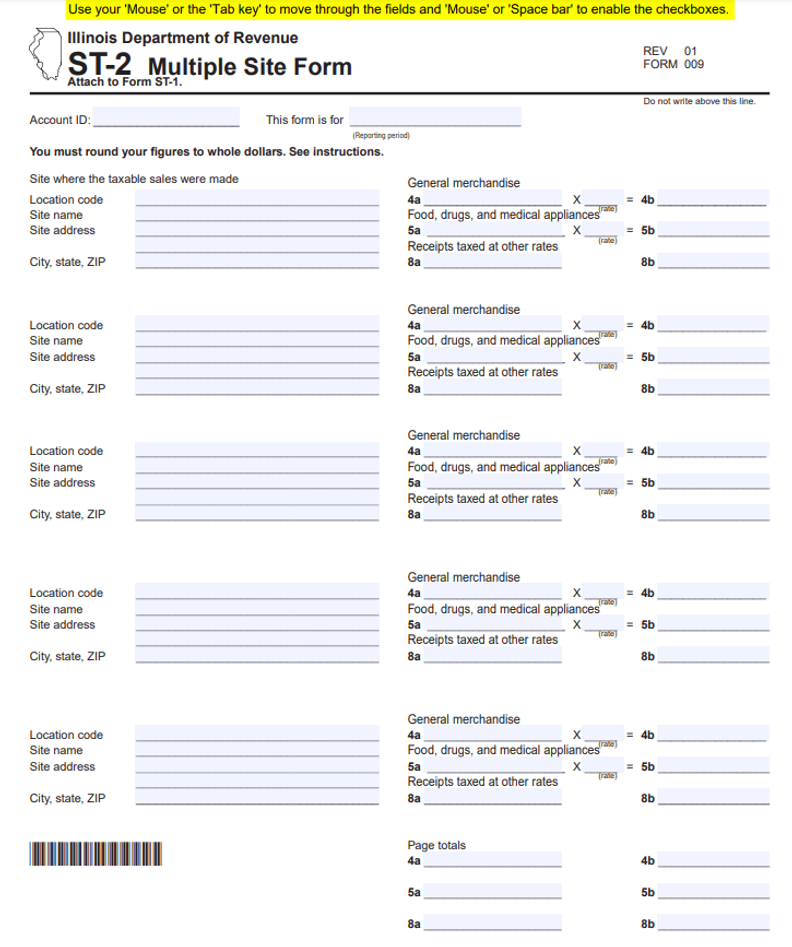
One thing that's gotten easier: You used to have to manually add or remove each sales location in your account before you could file for it. That's no longer required, when you file through MyTax Illinois, every jurisdiction where you've made a sale is available on one screen at filing time.
Who this applies to: If you're a remote retailer selling directly (not through a marketplace) and you've crossed the $100,000 threshold, you file both forms for your own sales. If you're a marketplace facilitator, you also use Form ST-2, both for sales you're collecting on behalf of marketplace sellers and for any of your own direct sales that meet the same destination-based criteria.
One costly detail to get right: If a sale's destination can't be determined, Illinois assesses tax on it at a flat 15% rate rather than the applicable local rate, well above any normal combined rate in the state. Accurate customer address data isn't optional here.
By the way, it's for exactly this reason that we recommend using a sales tax automation tool for Illinois. Jurisdiction-by-jurisdiction reporting by hand is tedious and easy to get wrong.
Frequently asked questions
What's the current economic nexus threshold for remote sellers in Illinois?
$100,000 in cumulative gross receipts from sales to Illinois customers. As of January 1, 2026, Illinois removed the 200-transaction threshold, so transaction count no longer matters, only the dollar amount does.
What is Retailers' Occupation Tax (ROT), and how is it different from Use Tax?
ROT is Illinois's destination-based sales tax, collected at both the state and local rate based on where the customer is located. Use Tax is the flat 6.25% rate remote sellers used to collect before the 2021 law change; ROT replaced that for sellers who meet the nexus threshold.
Do I need to collect Illinois sales tax on sales made through Amazon or another marketplace?
Not if the marketplace facilitator meets Illinois's own collection threshold, in that case, they collect and remit ROT on your behalf, and you don't report those sales on your own Form ST-1. You're still responsible for any non-marketplace sales, like through your own website.
What forms do I need to file as a remote seller in Illinois?
Form ST-1 (Sales and Use Tax and E911 Surcharge Return) and Form ST-2 (Multiple Site Form), which breaks your sales and tax collected down by the local jurisdiction where each customer is located.
Does having inventory in an Amazon FBA warehouse in Illinois count as physical presence?
No. FBA inventory storage alone does not create physical presence nexus in Illinois. You'd still be evaluated under the remote seller/economic nexus rules instead.
What happens if I collect the wrong tax rate on a destination-based sale?
As of 2026, if you can't determine the proper customer location for a destination-based sale, Illinois will assess tax on those sales at a 15% rate, well above any typical combined local rate, so accurate address data matters more than ever.
Let us simplify Illinois sales tax for you
Between the 2026 threshold change, marketplace rules, and jurisdiction-by-jurisdiction ST-2 filing, Illinois is one of the more detail-heavy states to get right on your own. If you're just getting started, download our Sales Tax Compliance Checklist. Not sure where you stand? Take our free Sales Tax Risk Assessment, 20 quick questions, about five minutes, for a personalized read on your exposure. And if you'd rather hand the whole thing off, our team handles Illinois sales tax for ecommerce sellers every day.
