

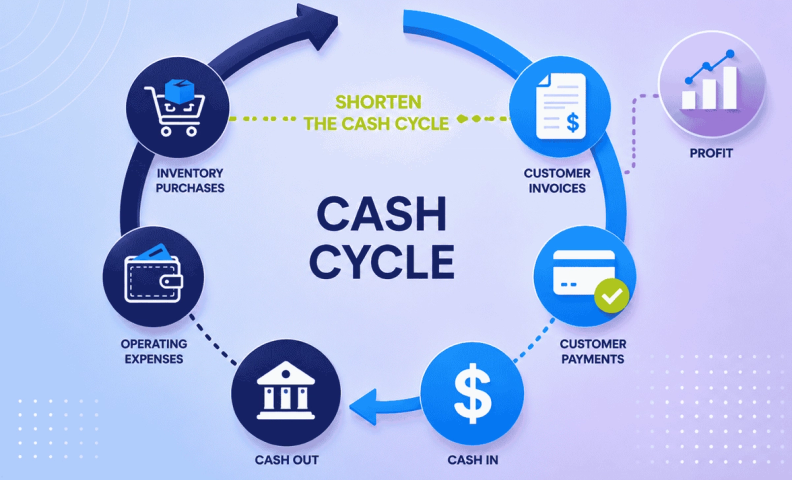
Small businesses generally have a good idea of how much cash they have on hand. They are vigilant in watching their bank account, because at the end of the day, cash is king. We like to say, “Revenue is vanity. Profit is sanity. Cash is king.”
But cash flow management is more than just knowing how much cash you have on hand. This article talks about what is involved in doing it well.
Understanding your business cash cycle
Profit does not always equal cash
If you are using accrual, not cash-basis accounting, profit does not always equal cash. Both profit and cash are important to understand and track. But remember that everything happening on your P&L doesn’t reflect as cash at the end of the day. It is actually possible to have a profitable business that runs out of cash because sales aren’t converting into cash quickly enough! Let’s investigate this idea more.
You may have recorded “Sales” for items or services you sold in a month, even though the customer hasn’t yet paid you. This delay between “Sales” and receiving cash is common and is reflected as accounts receivable on your balance sheet.
Another example of profits not equaling cash is when you use a credit card or other debt instrument for expenses. Although these expenses may be recorded on your P&L, you haven’t had to take cash out of your bank account yet.
Finally, inventory is a classic example. Inventory purchases usually require a large amount of cash up front. If you are recording Cost of Goods Sold correctly, you don’t record the up-front inventory purchase as an expense until items are sold. When items are sold, you then record Cost of Goods Sold for only those sold items.
Cash flow management and your business cash cycle
Good cash flow management for ecommerce businesses starts with understanding your own cash cycle.
- When does cash move out of your business?
- When does cash move into your business?
- Do you have periods of cash gaps?
- What would happen if one of your customers delayed paying you for a significant time period?
- What can you do to increase cash, so you don’t experience these gaps?
- What can you do to decrease your cash cycle?
The last thing you want to do is have a profitable business that isn’t able cover payroll during cash gaps.
Producing efficient cash flow from operations
When looking at cash flow management for small businesses, cash flow comes in different ways. Types of cash flow includes cash from operations, investing, and financing:
- Operations: Net cash that comes from selling your goods or services and the associated costs in operating your business
- Investing: Net cash from investing activities, such as purchasing and selling property and equipment.
- Financing: Net cash from debt or equity financing.
At the end of the day, cash flow created by operations is the most important and pure type of cash flow. You may be able to supplement negative cash flow operations with investing or financing cash for a period. But if your net cash flow from operations is consistently negative, you don’t have a long-term sustainable business.
Optimize cash with expenses
Small businesses need to develop good expense management practices that will help pay the bills while optimizing cash flow. This requires approaching accounts payable and expenses differently than as a consumer. Here are a few things to consider:
- Never pay early
- Payment terms matter
- Credit is your friend
Never pay early
Paying early decreases the cash you have on hand to grow your business, so pay when it's due and never before. Tools like Bill.com make this easy by letting you schedule and automate payments so they go out right on time. See why we like Bill.com.
Payment terms matter
Payment terms are negotiable, and it's worth treating them that way. Ask about a discount for paying early, and push for longer net terms wherever you can, especially once your purchasing volume gives you some leverage. If cash is tight, stretching out your payment terms is usually a cheaper option than reaching for other forms of credit.
Credit is your friend
Establishing business credit is worth prioritizing, and a business credit card is usually the easiest first step. Compare cash back rewards, points, other benefits, and fees before choosing one. We service a lot of ecommerce businesses and often suggest Brex's ecommerce program as a good fit for them, while Bill Spend & Expense is another solid option for small businesses more broadly.
Finally, we would recommend using credit cards to only float expenses, but not for financing. Make your payments on time and avoid interest fees (13-25%) as other debt options are less expensive.
Properly paying bills, negotiating payment terms, and using credit correctly is important to cash flow management for small businesses. Many of these suggestions do not cost any money while increasing your cash flow.
Optimize cash with receivables
On the other side of the equation, optimizing cash flow with receivables or collections is important. Sales are good, but collections are better. Small businesses need to chase that dollar and get cash in the door faster:
- Easy payment = fast payment = cash
- Factoring invoices
- Receiving payment terms also matter
Easy payment = fast payment
The easier it is for customers to pay you, the faster you will get cash. Consider the pros and cons of different options:
- Traditional invoicing: Harder for customers. Low cost to you. Payments will take longer.
- ACH options: Easier for customers. Minimal transaction fees. Payments may be faster.
- Credit card or other e-payment options: Easier for customer, but there will be transaction fees
Common tools that are available in helping small businesses receive payments are the following:
- QuickBooks Payments
- Bill.com
- Credit card payment options:
- PayPal, Square, and Stripe are most common but can be expensive
- Merchant service accounts are good as you get volume: Authorize.Net, Host Merchant Services
Factoring invoices
Factoring is the selling of invoices to a third-party factoring company. Instead of receiving cash from your customer, you can receive some of the cash faster from a factoring company.
- Amount of the invoice you can sell to the factoring company is typically 70-95%
- Fees are 1-5% depending on amount, quantity, and who owns the liability (you or the factoring company)
- Factoring companies vary and specialize. There are a lot of sharks, so you’ll want to shop around and maybe use multiple companies.
Fintech is starting to come out with factoring options. QuickBooks Online Instant is essentially a factoring option. Veem Capital also has a “Paid Now” option.
Receiving payment terms
Consider offering customers a discount for paying early, since that's one of the fastest ways to pull cash in the door. If you don't bring payment terms into deal negotiations, your customers will, so make sure you're the one setting them. Build late fees into your terms from the start, too. Late payments are going to happen, and it's better to have that covered upfront than to negotiate it after the fact.
Additional cash flow management options and strategies
Some final cash flow management options for small businesses include other debt and equity financing options:
- SBA and non-SBA long-term loans: These are good for capital investments (PPE). Make sure you understand terms such as collateral required and guarantees needed. Don’t get these loans without a plan for using capital and repayment.
- Business line of credit: These are good for large, infrequent purchases (inventory). This is an expensive option, so don’t consistently max out your line of credit.
- Equity capitalization: You can receive large investments upfront with little or no revenue or profits. But you will lose ownership/control and will need to have a business plan geared towards high growth and a liquidity event.
Use debt financing strategically
Using debt strategically is important. Are you supplementing a loss from operations cash flow? This should only be in emergency situations. Or are you using the debt to strategically generate more cash flow from operations? The latter question should be the focus with most debt financing.
When considering your options, don’t ignore cost of capital.
Cost of capital = average interest rate * (1 – tax rate)
“A wise company only invests in projects and initiatives that exceed the cost of capital” – Joe Knight
Here’s a cost of capital example:
- Average interest rate = 10%
- Tax rate = 35% (typical for a small business)
- Cost of debt = 10% * (1-35%) = 6.5%
You need to ask if you will be generating more than a 6.5% return with the debt option? If you are, by all means go ahead. If you are scared to use debt financing, simply do some cost of capital analysis and don’t hold your business back if your return will be higher than your cost of capital.
Frequently asked questions
Why can a profitable business still run out of cash?
Profit on your P&L doesn't always mean cash in the bank. Sales get recorded before customers actually pay, credit card expenses hit your books before cash leaves your account, and inventory purchases require cash upfront long before those items sell. Those timing gaps are exactly why a profitable business can still run out of cash.
What's the most important type of cash flow?
Cash flow from operations, the cash generated from actually selling your goods or services. Investing or financing cash flow can supplement a rough patch for a while, but if operations are consistently negative, the business isn't sustainable long term.
How can I optimize cash flow on the expense side?
Never pay bills early, since that just decreases the cash you have on hand to grow the business. Negotiate longer payment terms where you can, and use business credit cards to float expenses, not to finance them, so you avoid high interest fees.
How can I get cash from customers faster?
Make it as easy as possible for customers to pay you, since easier payment methods mean faster cash. You can also consider factoring your invoices to a third party for a fee, or negotiate early-payment discounts and firm late fees into your terms.
How do I know if using debt makes sense for my business?
Compare the return you expect to generate against your cost of capital, which is your average interest rate multiplied by (1 minus your tax rate). If the return from using that debt beats your cost of capital, it's worth using strategically rather than avoiding it out of caution.
Let us help you manage your cash flow strategically
Shortening your cash cycle, optimizing both sides of your ledger, and using debt only when the math actually favors it are the moves that keep a profitable business from running out of cash. Building your business credit early gives you more room to do all three. If you'd rather have a team handling this alongside you, that's exactly what we do for ecommerce sellers.
